
Hire Node.js developers and experts who raise backend choices early

Hire Node.js developers who settle where CPU-heavy work runs and what goes serverless while those choices are still cheap to change.

Abstract 3D illustration of a white hub with four pipes radiating out and small spheres inside them, one in orangeAbstract 3D illustration of a white hub with four pipes radiating out and small spheres inside them, one in orange

TECHNOLOGIES

Tools our Node.js developers work with

Node.js

Express

NestJS

Fastify

Koa

TypeScript

Socket.IO

GraphQL

PostgreSQL

MongoDB

Redis

Docker

THE CALLS THAT STICK

Which Node.js decisions are hard to reverse?

You get Node.js experts at the seniority you ask for, working in your team and your process. You interview them before anyone starts and can turn any of them down. We can also run the team for you, or provide Node.js consultants who advise, usually part-time or per project.

Our engineers build APIs, queue workers and integrations, in containers or on AWS Lambda and Azure Functions. You can extend your team with Node.js engineers, or hand us a whole build as a software project we deliver.

NestJS, Express or Fastify

A bare framework is a router and a blank page, fine for two engineers who agree. NestJS imposes modules and dependency injection, which earns its weight once a whole team shares the code.

Either Express or Fastify sits underneath, and NestJS runs on both. Fastify validates and serializes against JSON schemas. Write any of it in TypeScript once more than one person reads the code.

CPU work on the event loop

Node.js runs your JavaScript on one thread. A PDF export that takes two seconds of CPU stalls every request queued behind it.

That work belongs in worker threads, a job queue with its own worker, or a separate service. Spotting it is where Node.js performance work starts, so ask any candidate where they would put it.

The code you didn't write

Your production install includes each runtime dependency and everything it pulls in. Under npm's defaults, an install script runs on your machines, so treat it as code too.

Add packages reluctantly. Commit the lockfile and install from it in CI, and when a direct dependency is upgraded, read its changelog before the pull request merges.

Serverless or always-on

AWS Lambda and Azure Functions suit spiky, event-driven work that finishes within their run-time limits.

Steady traffic and long-lived connections such as Socket.IO want a long-running service. Switching later means reworking how the app connects and holds state.

Moving a backend to Node.js

We start by analyzing what you run. From another language, moving is a rewrite, so pick the routes or services that can go first behind the API your clients already call.

Each cut-over keeps a way back, and your clients shouldn't notice it. Sometimes the better plan is to upgrade what you run and use Node.js only for new services.

Want us to run the whole team?

Priorities shift every sprint? A dedicated Node.js team gives you agreed capacity that we keep staffed.

CASE STUDIES

Node.js in backends and between systems

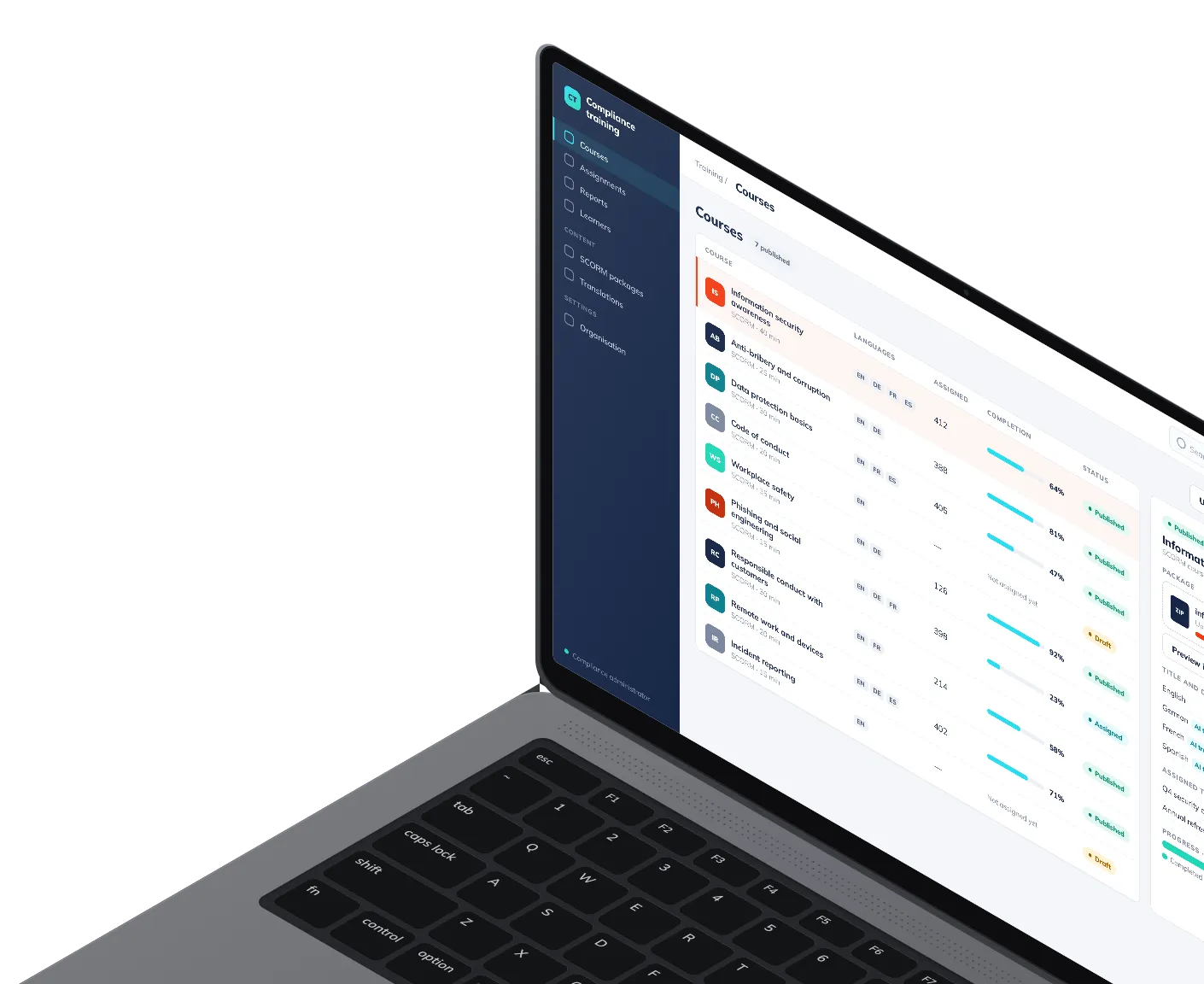
For a GRC software company we built a NestJS backend for a compliance training module. The browser sends large SCORM packages straight to AWS S3 through signed URLs, past the API gateway that would have refused them. Our client reports that the customers flagged as likely to leave stayed.

PROCESS

From your request to signed contracts

These are usual times for each step. What we commit to is presenting candidates within 7 days of your request. A CV that lists NestJS and five years is a claim, and our checks test it before a profile reaches you. Hiring for other stacks too? See our developers by technology.

  1. STEP 1

    Requirements call

    We agree the scope, the seniority and where the engineer fits in your team.

    Usually 1 day

  2. STEP 2

    Matching vetted candidates

    We match candidates to your brief. Each has passed our technical skills assessment, soft-skills evaluation and CV check, plus live coding for some roles.

    Usually 1–2 days

  3. STEP 3

    Your interview

    You interview the candidates you choose, and our technical interview and live coding can sit inside your selection, with full visibility for you.

    Usually 1 day

  4. STEP 4

    Contracts and onboarding

    We handle the contracts, then set up security and access with your team.

    Usually 1–2 days

HOW WE WORK

Engagement models and terms

Staff augmentation

Our engineers join your team and work in your process and tools. You manage them; we source, vet and contract them.

Hourly rate per engineer by role and seniority, invoiced monthly.

  • If an engineer isn't the right fit, we replace them within 14 days at no extra cost.
  • Knowledge transfer to the replacement engineer isn't billed.
  • There is no free trial period.
  • 30 days' notice to take an engineer off or end the engagement, with no minimum term beyond it.
  • Out-of-hours on-call only if agreed with you; we set its hours and billing together.
  • After two years, moving an engineer onto your own staff is something we can discuss.

Managed team

An agreed team capacity that we manage. We coordinate delivery and handle the team's make-up. You set the priorities and own the backlog.

Per-engineer rates, or a fixed monthly fee for the agreed capacity.

  • We handle replacements ourselves, and the team keeps its agreed capacity and pace.
  • Engineers work full-time for your team only.

Whichever model you choose

  • We reply to an inquiry from the contact form within 24 hours.
  • We sign an NDA before work starts, and IP passes to you on payment.

DAY TO DAY

How our engineers work inside your team

Abstract 3D illustration of white rounded blocks joining a row of server-like slabs linked by pipes, one block in orangeAbstract 3D illustration of white rounded blocks joining a row of server-like slabs linked by pipes, one block in orange

Your backlog, your tech lead

Under staff augmentation the engineer takes tasks from your backlog, works in your tools and reports to your tech lead. You direct the work, and we handle the contract and stay in touch.

AI-written code gets two reviews

Our engineers use AI tools where your rules allow, then read, fix and test the output before opening a pull request. Another AI agent reviews it, then a human engineer, before it merges.

Named accounts you issue

Repository access runs through individual named accounts you create, limited to what the role needs and removed when the engineer leaves. No shared logins, so every commit has a name on it.

Upgrades before end of life

Every Node.js major release has a published end-of-life date, after which it gets no security fixes. Put the upgrade in your backlog early, and the engineer takes it like any other ticket.

BY THE NUMBERS

7 years

Average experience, company-wide

80%+

Senior-level or above, company-wide

50+

Projects delivered by our team

7 days

To present matched candidates

Talk through your Node.js backend

"A strong backend engineer asks what a decision will cost to undo before writing the code. That's the habit I'd want on any team."

Dzmitry Kuchynski, Chief Operating Officer, Octalance

FAQ

What buyers ask us before signing

How soon can a Node.js engineer start?

The 7 days on this page is the time to present matched candidates. It can happen sooner, but that isn't guaranteed. The start follows your interview and onboarding, where contracts, security and access usually take 1 to 2 days. A managed team takes up to a month to start, depending on its size, and can begin with a few developers.

What happens if an engineer isn't the right fit?

With staff augmentation, we replace them within 14 days at no extra cost. Raise it early. A mismatch named in week two is easier on everyone than one named in month three. The rest of the terms are under Engagement models and terms on this page.

What is the price built from?

Staff augmentation is an hourly rate per engineer, set by role and seniority and invoiced monthly, so your bill follows how many engineers you use and for how many hours. We agree the rates with you for each request and don't publish a list, because they vary too much by role and location.

Who owns the code your engineers write?

The code usually lives in your repositories, and it can sit in ours if that suits you better. In your repositories, you hold both the code and the accounts our engineers use, so the commit history and the access stay with you when an engagement ends. The IP becomes yours once you have paid for the work.

We already have a team and a codebase. How do your engineers fit in?

That is the setup staff augmentation suits best. You have a tech lead and a process, and you need more capacity or a skill you lack. We match your hours by choosing where the engineer works from and shifting their schedule. For a US team we can arrange 4+ hours of daily overlap with the West Coast.

Can your engineers take over a Node.js codebase another team wrote?

Yes. If we look after it as support and maintenance, it starts with an audit: we read the code, its dependencies and the deploy and release setup, find the missing tests and documentation, and give you a written list of findings with what we would fix first. A short handover follows, covering access, environments, runbooks and a walkthrough from the previous team where one is available.

Can you move our backend to Node.js without stopping delivery?

Where the design allows and your requirements agree, yes. We move it part by part, so the parts still on the old stack keep shipping, and each cut-over has a way back if the switch fails. We'd suggest starting with a part where a mistake costs little, and letting what you learn there set the order for the rest.