Target state, cloud or hybrid
Which platform holds which data, and which systems stay where they are. A hybrid that leaves some systems on-premises is often the right answer when moving them costs more than it returns.


Our data architecture services start from what you run today and end in a target design and a roadmap, ready for your engineers or ours to build.
WHERE IT STARTS
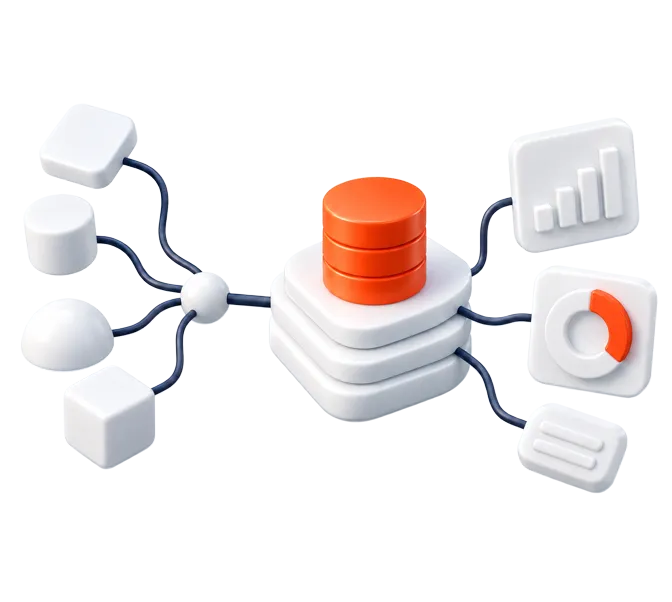
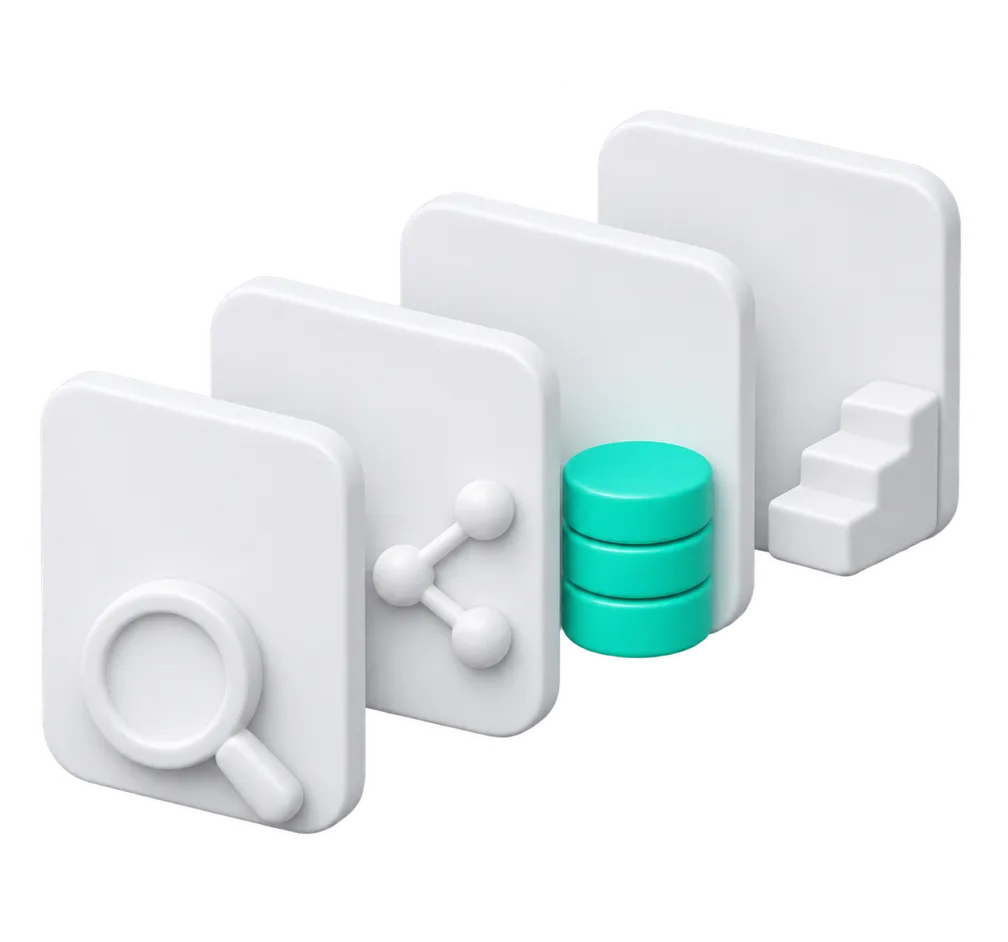
A data architecture is the written design of where your data lives, how it moves between systems, who owns each part and which platform holds it. We deliver it as four documents: a current-state assessment, target-state diagrams, a platform recommendation and a phased roadmap. The arguments then happen on paper, before the next build.
Finance and sales bring two revenue figures to the same meeting. A dashboard number can't be traced back to any source. A new source takes weeks to join, because each data pipeline was built for one report, and the cloud bill grows faster than anyone can explain. Those are design problems, and another round of engineering on top rarely fixes them.
You may not need this at all. If your reports agree and a new source slots in without a rebuild, the architecture is doing its job, and the money is better spent on the next pipeline. If the real goal is a model, preparing data for AI is the narrower job to start with.
DELIVERABLES
A data architecture assessment of what you run today: every source, pipeline, store and report, and who owns which data. It records where numbers drift apart, where loads fail or slow down, and which parts of the bill no workload accounts for. A roadmap needs this first, since nobody can order fixes for problems nobody has found.
Diagrams of the platform you are moving toward: which systems feed it, where each kind of data is stored, how it flows from raw to reporting-ready and where access is controlled. They are drawn for two readers, the engineers who build it and the people who approve its budget. They also show where each shared metric, such as revenue, is defined and calculated, and who owns the definition. A new source can be placed on them before anyone writes code for it.
A single platform recommendation with the reasons written down, so your engineers can challenge it and whoever signs the budget can follow the argument. Of everything in the design, the platform is the hardest choice to reverse, which is why it gets a document of its own.
Every change in priority order, grouped into phases with the dependencies between them. Each phase can be estimated and built on its own, and the plan still makes sense if you stop after phase one. Where a phase moves data, the roadmap includes a way back at cutover.
SCOPE
The design covers the whole platform, on AWS, Azure or Google Cloud, or as a hybrid that keeps some systems on-premises. It decides four things that are expensive to change later: where the target state runs, how storage is layered, how data gets in, and who may touch it.
Architecture is the drawing. Building the data warehouse and its pipelines is engineering, and data model design settles the tables inside it. Both are separate jobs, and we take on either as part of the wider data practice.
Which platform holds which data, and which systems stay where they are. A hybrid that leaves some systems on-premises is often the right answer when moving them costs more than it returns.
How storage is split into layers, from raw data to tables a report can trust, on Snowflake, Databricks, Redshift or BigQuery.


How each source reaches the platform and who owns each data pipeline once it runs. Streams cost more to run, so they go only where a decision needs data within minutes.
Our engineers work with Airflow, dbt, Fivetran, Kafka and Spark.


Data governance drawn into the first version of the design: who owns each dataset, who can reach what, and where lineage and metadata are recorded.
Quality checks sit where data enters, because a bad record is cheapest to stop before it reaches a report that someone has already forwarded to the board.


PATTERNS
A warehouse fits when most questions are structured reporting on data you can model: revenue, orders, stock. It is the simplest of these patterns to run well. Kimball dimensional models deliver one business process at a time, an Inmon-style normalized core suits one enterprise-wide model, and Data Vault fits many sources that change often and need full history. It fits badly when data scientists need the raw files a warehouse is not built to keep.
A data lake goes wrong when people report straight off it. With no owners and no catalog, it turns into a folder of files nobody trusts. Used for what it does well, it holds raw and semi-structured files cheaply until someone needs them, such as event logs, documents and data science work. Most teams that need a lake also need a warehouse beside it.
A lakehouse keeps raw and modeled data on one storage layer and promotes it through medallion-style stages, from raw to reporting-ready, so analysts and data scientists read the same tables. It pays off when both groups are real and growing. For a team that only runs reports, it is more platform than the problem needs. Databricks is the usual candidate, and lakehouse architecture on Databricks is a service of its own.
The hard part of a hybrid is the boundary. Some systems stay on-premises because they are costly to move, tied to hardware or held in place by a contract, and the rest move to the cloud. If nobody draws the line between the two halves, every report needs data from both and no one owns the join. The design draws that line first.
A data mesh gives each dataset to the business domain that produces it, under standards shared across the company. A data fabric lays one metadata and integration layer over sources that stay where they are. Both pay off with several teams that can each run their own data, and with a single data team the overhead usually outweighs the gain.
We weigh four things: the workload and data volume, the cloud you already run and what your team can operate, the cost at your expected volumes, and which sources must connect. The written platform recommendation shows how each candidate compares on all four.
PROCESS
We start from what you already run, and draw nothing until we have read it. An architect, a business analyst and a delivery manager run discovery and design, reading pipelines, schemas and reports with the people who maintain them.

STEP 1
We map your sources, pipelines, storage and reports, and the decisions each one feeds.

STEP 2
We shortlist platforms only after reading your sources and reporting needs, then test each against your criteria.

STEP 3
We draw the target state, then break the route there into phases with their dependencies.

STEP 4
Our data engineers can build to the design alongside your team, or take the whole build on as a project.
CASE STUDIES
For a global mobile software developer, we moved the heaviest sources of its Redshift warehouse to Redshift Spectrum and gave an ML model's calculations a separate pipeline on AWS Batch and Docker. ETL moved from Python scripts to Airflow. The client got 6x faster queries, 12x faster raw data collection and 98.8% savings in computing resources. The case reports these figures for the project as a whole.
A professional education company had a warehouse on Amazon Redshift, while its Salesforce, Shopify and SAP data sat outside it. After analyzing its sources, reporting needs and existing architecture, we chose Fivetran for ingestion and dbt for modeling, then built the pipelines that brought that data in, with validation and monitoring.
A trading platform for crypto and tokenized assets took its analysis data from one API. Retrieval was inconvenient, and changing the API wasn't an option. We left the API as it was and built a Python wrapper library over it, which streamlined retrieval without compromising data integrity. The same data pull now runs 3x faster through the library.
IN YOUR SYSTEMS
In your warehouse, cloud account and source systems, we work through named accounts you issue, each limited to what that person's part of the work needs, and removed when they leave.
Systems we control are hosted in the EU. Your warehouse and cloud account stay wherever you keep them, and the design works around your rules for where data may live.
We hold no partner status with AWS, Microsoft, Snowflake or Databricks, so the pick follows your criteria. Our team includes certified AWS, Azure, Snowflake and Databricks engineers.
The design is written for whoever builds it. Your team can build from it alone, or we can add engineers to implement the architecture beside them.
TERMS
We deliver an agreed scope end to end: plan, team, milestones, QA and release. You make the product decisions and accept each milestone.
Fixed price per milestone after discovery, or time and materials against an estimate.
A short phase before a build: requirements and backlog, architecture, an estimate and a delivery plan.
Fixed price, usually 2–4 weeks.
Our engineers join your team and work in your process and tools. You manage them; we source, vet and contract them.
Hourly rate per engineer by role and seniority, invoiced monthly.
MORE CASE STUDIES
Most architecture decisions are made before anyone knows the real load, the next platform or the next question the business will ask. A design that ages well doesn't bet on one answer. It keeps the part most likely to change cheap to move.
A fintech warehouse we built keeps its transformation logic in Python and Airflow, outside Vertica, so a later move means repointing pipelines, not rewriting them. A health app's pipeline had to scale with a load nobody could forecast, and a load test found its cost problems before launch.
Tell us which sources feed your reports and where the numbers lag. We will suggest where the assessment should start.

FAQ
Our discovery phase, which usually takes 2–4 weeks, comes first. The architecture work around it has no standard length: it depends mostly on how many sources you have and how well they are documented. Ten well-described sources go faster than four that only one person understands.
The discovery phase has a fixed price, set by the size of what is being designed and who joins it, such as a lead engineer. If you go on to a build, project delivery runs at a fixed price per milestone, or as time and materials against an estimate. The Engagement models and terms section compares the models we offer.
You do. All four documents are yours to keep, even if another team does the build.
Each engineer signs in through your own identity system, so you can see and revoke their access yourself. An assessment rarely needs more than read access. We sign a data processing agreement wherever we handle your data.
No. The platform is picked on criteria you agree with us, and every reason is on paper for your team to check. It can also be the platform you already run.
Your architect or data lead keeps the final say. Our written recommendation is there to be argued with, and it is usually better for it. When the build starts, our data engineers can join your team and work in your process and tools.