Hire AI engineers whose LLM features and agents hold up in production

Hire AI engineers tested on RAG design, latency, cost and model drift before you see a profile. We present matched candidates within 7 days.

Abstract 3D illustration of a white dome ringed by stepped arches like ripples, one orange pearl at its centerAbstract 3D illustration of a white dome ringed by stepped arches like ripples, one orange pearl at its center

WHAT THEY BUILD

What would an AI engineer build for you?

An AI engineer builds LLM features, agents and machine learning models into your product, then keeps them working well, at a cost you can plan, once real users arrive. Tell us what the person should ship, the seniority and your stack, and we shortlist engineers tested on that kind of work.

No one on your side to direct engineers day to day? Then hiring is the wrong first step. We also take on AI development as a project, starting with a fixed-price discovery phase, usually 2 to 4 weeks, that tests whether AI is the right answer at all.

LLM apps and RAG systems

Assistants and internal tools that answer from your own documents: chunking, embeddings, a vector store such as pgvector, and answers that cite their sources.

Retrieval should be tuned and checked on its own, with hybrid search and reranking, before anyone judges the answers, since many wrong answers start with a wrong passage.

AI agents and workflows

Multi-step work that calls tools, built with LangGraph or LangChain and connected to your systems over MCP.

Our engineers give an agent only the access its job needs. Actions that are hard to undo, such as payments or messages to customers, wait for a person to approve them.

LLM and API integration

The OpenAI API, Claude, Amazon Bedrock or a self-hosted Llama, called from the software you already run, with calls traced in Langfuse or LangSmith.

Good LLM integration plans for the day the provider's API goes down or the bill doubles, with access control, cost limits, a fallback and a smaller model for simple requests.

Machine learning and MLOps

Models for forecasting, anomaly detection, scoring or text classification in PyTorch, TensorFlow or scikit-learn, trained on your own data.

After launch the work is MLOps. Model versions can sit in MLflow's model registry, and when monitoring shows drift, the model is retrained or rolled back.

BY THE NUMBERS

7 years

Average experience, company-wide

80%+

Senior-level or above, company-wide

50+

Projects delivered by our team

AI ROLES

Which AI engineer role do you need?

Application engineers, machine learning engineers and the roles around them

Application or model work

AI job titles overlap, so describe the work before you pick a title. Application engineers build on models someone else trained: LLM features in your product, AI agents that act on your systems, RAG over your documents. Machine learning engineers train and deploy models of their own, then run the MLOps around them.

On application work, the method follows the problem. Prompting is enough when a hosted model already knows the subject. RAG fits when answers must come from your documents. Fine-tuning, with LoRA for example, is for a format or a domain that prompts can't teach, and it is the step teams tend to reach for too early.

Many products need both roles, one after the other: an application engineer for the first LLM feature, and a machine learning engineer once a hosted model stops being enough. We staff both, and the brief you send decides the match.

The roles around an AI engineer

If you don't yet know whether a model is worth building, start with a data scientist who tests the idea on your data. An AI engineer then turns the result into a service your product can call. If your records are scattered across systems or out of date, the first hire may be a data engineer, who builds the pipelines a model reads from.

Most of this work is in Python, and the APIs and data services around a model often need a Python backend engineer as well.

Abstract 3D illustration of two stacks of white blocks joined by an orange block, an application role beside a model roleAbstract 3D illustration of two stacks of white blocks joined by an orange block, an application role beside a model role

TECHNOLOGIES

Tools our AI engineers work with

Python

PyTorch

scikit-learn

Hugging Face

LangChain

LangGraph

Langfuse

Ragas

OpenAI API

Claude

Gemini

Llama

Amazon Bedrock

Azure OpenAI

Vertex AI

MLflow

Not sure which AI role fits the work?

Describe the feature or model you have in mind, and we will tell you whether it needs an application or a machine learning engineer.

PRODUCTION READINESS

How is an AI engineer tested for production work?

What we check before your shortlist, and what you can ask yourself

What our vetting tests

In production a model has to answer quickly under real load and stay within its budget, month after month. That is the work we test for.

Every candidate goes through three steps before reaching your shortlist: a technical skills assessment, a soft-skills evaluation and an analysis of their job history. For AI and machine learning candidates, the assessment covers production scenarios, from designing a RAG pipeline or an evaluation set to trading latency against cost and handling model drift. For some roles a live coding interview follows, where the candidate writes code and talks through each choice. A background check runs only when a client asks for one.

Questions to ask before hiring an AI engineer

Whoever you hire, from us or elsewhere, ask how they handled these in a system that was already live.

  • How did they keep latency, the time a user waits for an answer, acceptable under real load?
  • How did they notice model drift, whether live data moved away from the training data or a provider changed the model behind its API?
  • How did they cap token and compute costs?
  • How did they test output against a fixed evaluation set, with Ragas or a harness of their own, before and after each change, and what did they trace once the system was live?

A strong answer names the trade-off and what was measured. A vague one usually means the work stopped at the notebook.

When you take on AI engineers who work inside your team, you interview each candidate before anyone starts and can turn any of them down. With a managed AI engineering team, we put the team together and answer for it, and you can interview the key roles.

Access to your systems

Our engineers reach your systems, data and model APIs only through named accounts you issue, with the access their role needs. All of it is removed when they leave the engagement.

AI work we can show you

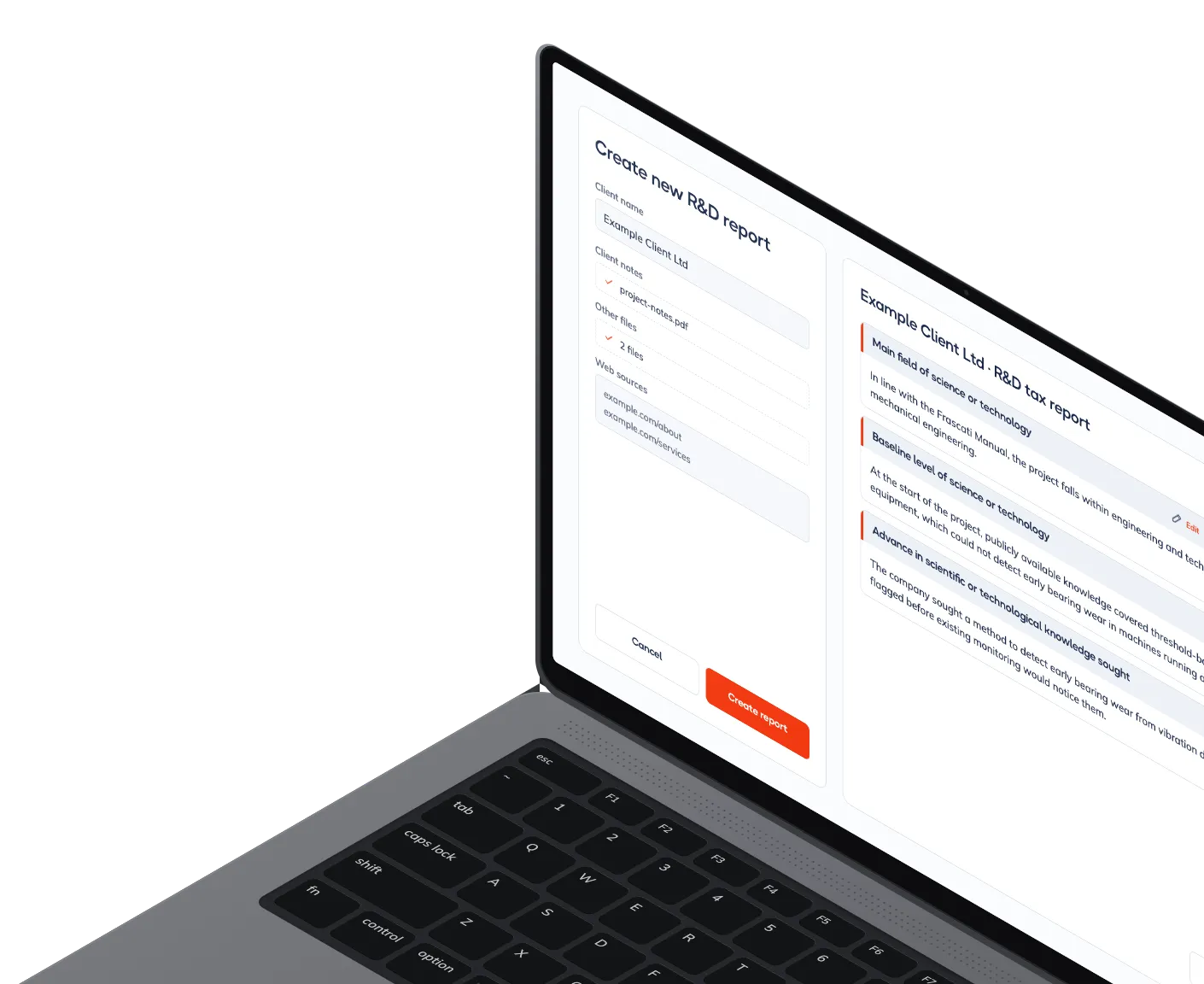
R&D tax report generation is our published generative AI case, a RAG system on Azure OpenAI that drafts a consulting firm's reports inside the firm's own Azure account. For predictive machine learning, start with logistics demand forecasting, a forecasting system we rebuilt on Databricks and Azure. More of our AI work sits under client NDAs.


Abstract 3D illustration of a white block passing three vetting checkpoints in a row, each marked by an orange lineAbstract 3D illustration of a white block passing three vetting checkpoints in a row, each marked by an orange line

CASE STUDIES

AI and machine learning projects we delivered

The tax firm's drafting system is application work on a hosted model, and no model was fine-tuned for it. The demand forecast and the travel company's revenue model are machine learning work, models we built into each client's data pipeline.

Logistics

Logistics company raises demand forecast accuracy from 70% to 92%

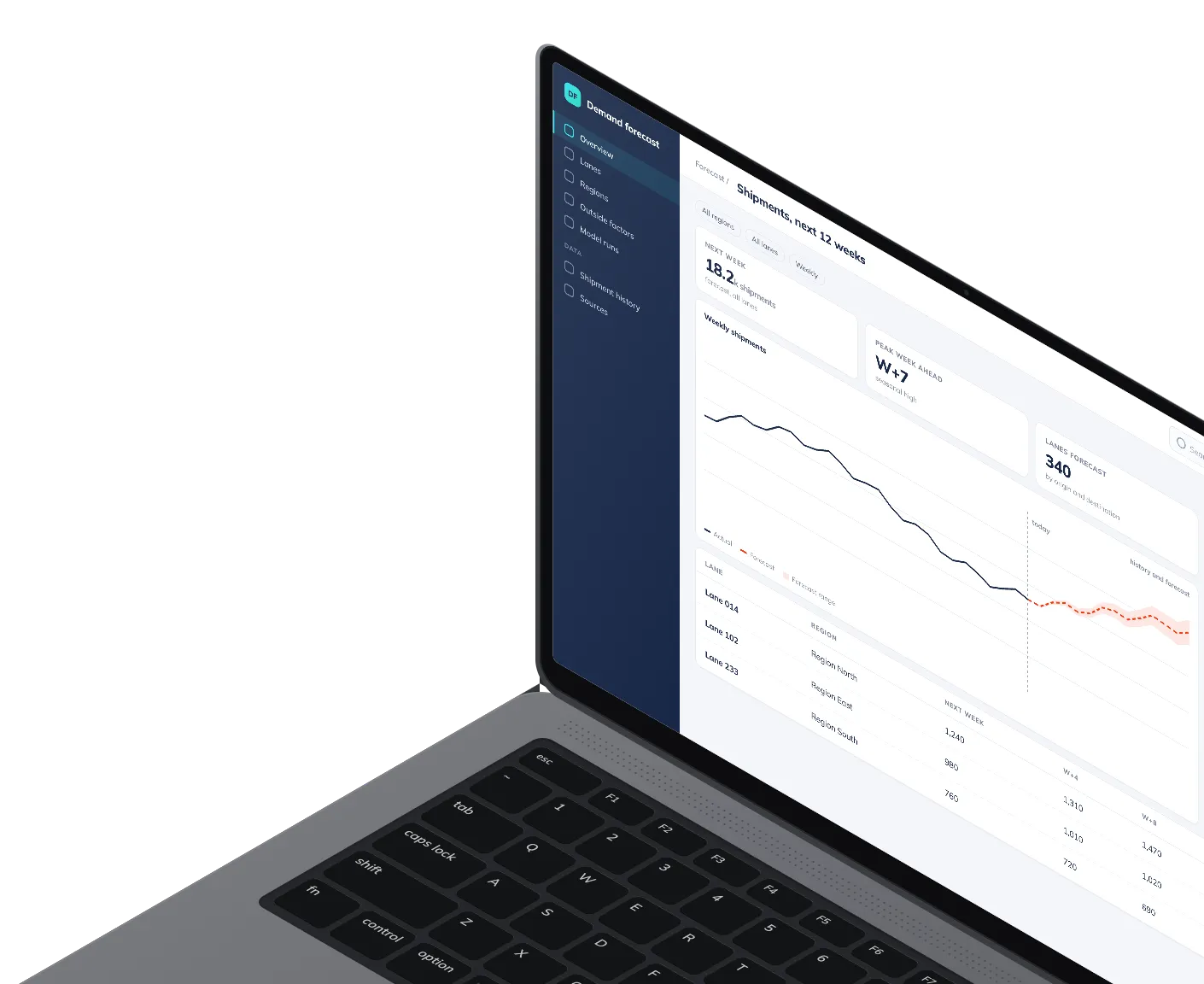
Demand forecast dashboard on a laptop: weekly shipments with the forecast and its range ahead, the model's inputs, and the busiest regions and lanes

PROCESS

What happens after you send the brief

The time on each step is the usual one, and it varies with the role. The commitment we make is matched candidates within 7 days of your request. A brief that names the models you call and the traffic the feature must handle lets step 2 match on the problem as well as the stack.

  1. STEP 1

    Define the AI role

    We agree the work, the seniority and the stack, from LLM application work to agents or machine learning, plus the models, data and cloud you already run.

    1 day

  2. STEP 2

    Match tested candidates

    We shortlist engineers whose assessed skills fit your AI stack and the production problems you described.

    1–2 days

  3. STEP 3

    Interview your shortlist

    You meet the engineers on the shortlist and pick who joins your team.

    1 day

  4. STEP 4

    Contracts and onboarding

    Contracts and an NDA are signed, then security setup and access to your systems.

    1–2 days

HOW WE WORK

Engagement models and terms

Staff augmentation

Our engineers join your team and work in your process and tools. You manage them; we source, vet and contract them.

Hourly rate per engineer by role and seniority, invoiced monthly.

  • If an engineer isn't the right fit, we replace them within 14 days at no extra cost.
  • Knowledge transfer to the replacement engineer isn't billed.
  • There is no free trial period.
  • 30 days' notice to take an engineer off or end the engagement, with no minimum term beyond it.
  • Out-of-hours on-call only if agreed with you; we set its hours and billing together.
  • After two years, moving an engineer onto your own staff is something we can discuss.

Managed team

An agreed team capacity that we manage. We coordinate delivery and handle the team's make-up. You set the priorities and own the backlog.

Per-engineer rates, or a fixed monthly fee for the agreed capacity.

  • We handle replacements ourselves, and the team keeps its agreed capacity and pace.
  • Engineers work full-time for your team only.

Project delivery

We deliver an agreed scope end to end: plan, team, milestones, QA and release. You make the product decisions and accept each milestone.

Fixed price per milestone after discovery, or time and materials against an estimate.

  • Scope changes go through change requests.
  • On fixed-price projects, a warranty period agreed in the contract, usually 30–60 days.

Whichever model you choose

  • We reply to an inquiry from the contact form within 24 hours.
  • We sign an NDA before work starts, and IP passes to you on payment.

Get a shortlist tested on production work

"Anyone can build a demo. We test whether a candidate can keep the model accurate and affordable once it is live."

Dzmitry Kuchynski, Chief Operating Officer at OctalanceDzmitry Kuchynski, Chief Operating Officer at Octalance

Dzmitry Kuchynski, Chief Operating Officer, Octalance

FAQ

What buyers ask before they hire an AI engineer

How much does it cost to hire an AI engineer?

It depends on the seniority you need and on how many engineers you use. Under staff augmentation you pay an hourly rate per engineer by role and seniority, invoiced monthly, at a rate agreed with you. Paying more for someone who has dealt with drift and model costs before can be cheaper than rebuilding a feature that only worked in testing. The other models and their price types are under Engagement models and terms on this page.

What do you need from us to start hiring an AI engineer?

A short brief does the job. Say what the person should ship in their first months, the seniority, and the models, clouds and tools you already run. Tell us whether your data may leave your environment, since that changes who fits. And say who will direct the work day to day, because that decides the engagement model.

Can you also staff machine learning engineers and data scientists?

Yes, both. The assessment changes with the role. AI and machine learning candidates get the production scenarios described on this page. Data scientists get statistics and experiment design, SQL and Python on real data, and a modeling task judged on its validation and on how they explain the result. That task checks for data leakage, a validation split that fits the data and a comparison against a simple baseline.

Can I sit in on the technical interview, or ask for a background check?

Under staff augmentation, yes to both. Our technical interview, and the live coding interview for the roles that have one, can be part of your own selection, with full visibility for you. A background check, which verifies that the CV is genuine, runs when a client asks for it.

Who owns the code our AI engineers write?

You do. IP passes to you on payment, and the code usually lives in your repositories. Keep the prompts and evaluation sets there too, versioned with the code, so whoever works on the system next can rerun the same tests.

Can our data stay in our own cloud when engineers use model APIs?

It can. A build can call its models through your own Amazon Bedrock, Azure OpenAI or Google Vertex AI account, so the model runs under your account, in your cloud. Before any data goes to a third-party API, agree what may leave your systems, and redact personal fields first. When nothing may leave, a self-hosted model such as Llama or Mistral is the option. A document assistant should also respect the permissions of the person asking and be guarded against prompt injection, where text inside a document tries to override the model's instructions. Releases go out in stages, with a person reviewing uncertain output at first.

Does the EU AI Act apply if we are not an EU company?

It reaches you if you put an AI system on the EU market or its output is used there, wherever your company is based. Its obligations scale with the system's risk level and are heaviest on the provider: the company that develops a system, or has it developed, and offers it under its own name, whoever wrote the code. Companies that only use a system carry duties of their own too. Whether a given system is in scope, and in which risk category, is a question for your counsel.