
Generative AI development services that ship LLM features in your product

Generative AI development services from the company that built a system drafting R&D tax reports from a consulting firm's own documents.

Illustration of company documents feeding a language model that drafts a cited answer inside a product windowIllustration of company documents feeding a language model that drafts a cited answer inside a product window

GENERATIVE AI

What does a generative AI build include?

A generative AI build is software around an LLM. It can mean chatbots for your customers, a copilot inside the tools your staff use, or a drafting or summary feature. Most builds pair the model with RAG, so each answer rests on passages retrieved from your own documents, and all of it is tested before launch.

The model writes fluent text whether it is right or not, and a confident wrong answer, the hallucination, reads exactly like a correct one. Grounding ties each answer to the passage it came from, so a reader can check it. Forecasting demand or scoring churn is machine learning, a different discipline, and it belongs to our wider AI development work.

Diagram of a language model linked to a document store, a customer chat window and a drafted textDiagram of a language model linked to a document store, a customer chat window and a drafted text

CHOOSING AN APPROACH

Which approach fits: API, RAG or your own model?

Start with a hosted model API

The quickest start is a hosted model, called through the OpenAI API, Anthropic Claude or Google Gemini. It fits drafting, summaries and other tasks where general knowledge matters more than yours, as long as your data may go to the provider under its terms. Start there and let the failures tell you what to add. When the model lacks facts only you hold, add retrieval. When the content is right and the shape is wrong, better prompts usually fix it before fine-tuning is worth a look.

RAG, when answers must come from your documents

RAG stores your documents as embeddings in a vector store. For each question it finds the passages that match, by meaning and by keyword, and hands them to the model, so the answer can cite its source. Answers are only as current as the documents behind them, which is why preparing the data a model needs often comes before the build.

Fine-tuning, when tone or format must hold

Fine-tuning trains an existing model further on your own examples. Reach for it when prompts can't hold a house tone, a fixed output format or a labeling scheme, or when a smaller, cheaper model should take over one narrow task. It is the wrong place to keep facts that change. A fact trained into a model goes stale there, and nobody can open the model to correct it, while a document in a RAG index can be fixed the same afternoon.

Your own cloud account, or a self-hosted model

A model can be called through your own Amazon Bedrock, Azure OpenAI or Google Vertex AI account, so it runs under your account in your cloud, next to the data it reads. Where data must not leave infrastructure you control, an open-weight model such as Llama or a Mistral model can run there in place of a hosted API. That gives you the most control, and it also makes your team the one that runs the GPUs and installs each new model version.

When the system has to take actions

A system that plans steps, calls tools and changes records is an agent, and a wrong step there is an email already sent or an order already cancelled. That makes building an agent a separate job, scoped around which tools it may touch and which actions wait for a person.

Decision diagram comparing a hosted model API, retrieval over your documents, fine-tuning and a self-hosted modelDecision diagram comparing a hosted model API, retrieval over your documents, fine-tuning and a self-hosted model

CASE STUDY

Why we kept the firm's knowledge out of the model

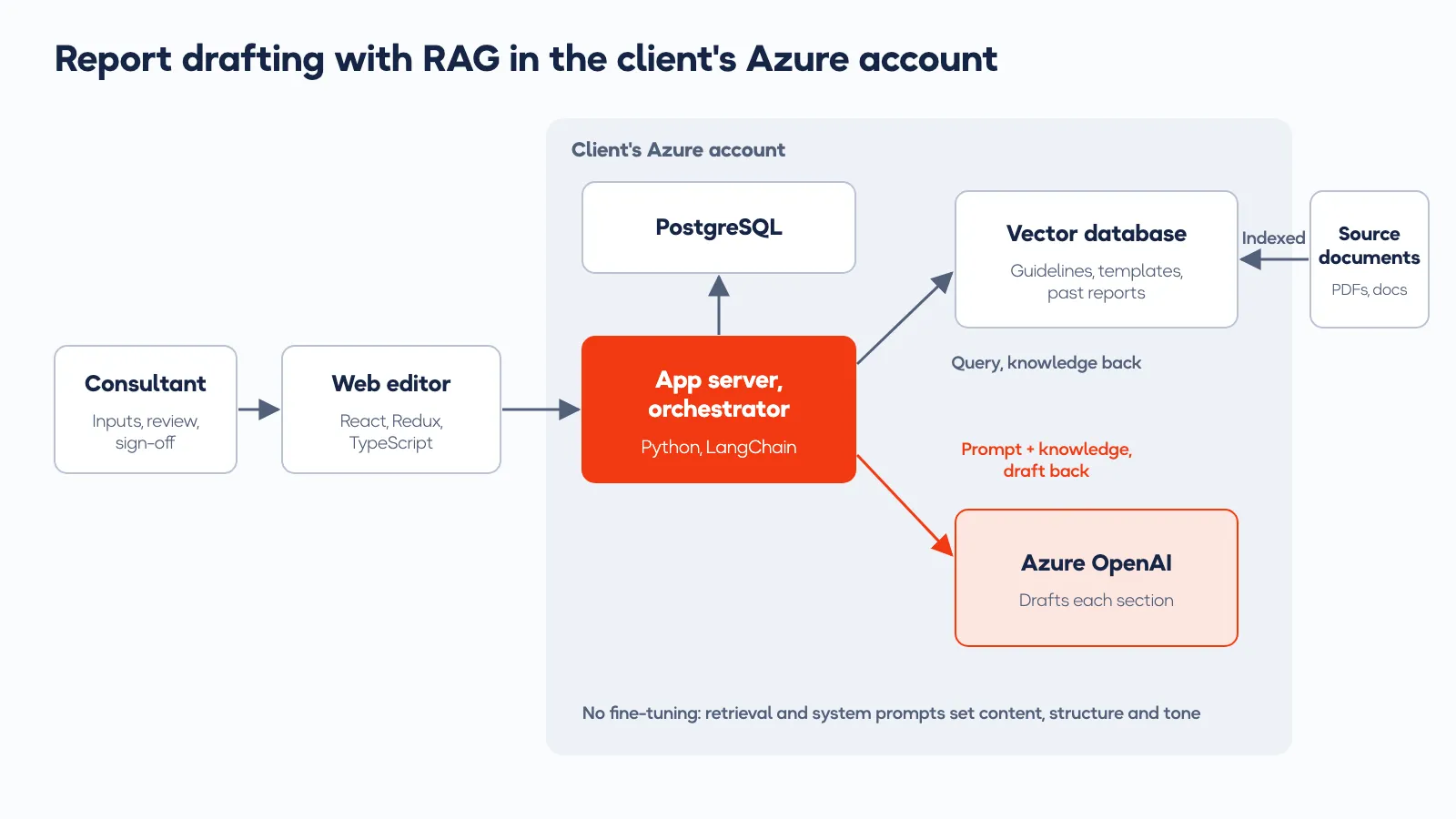
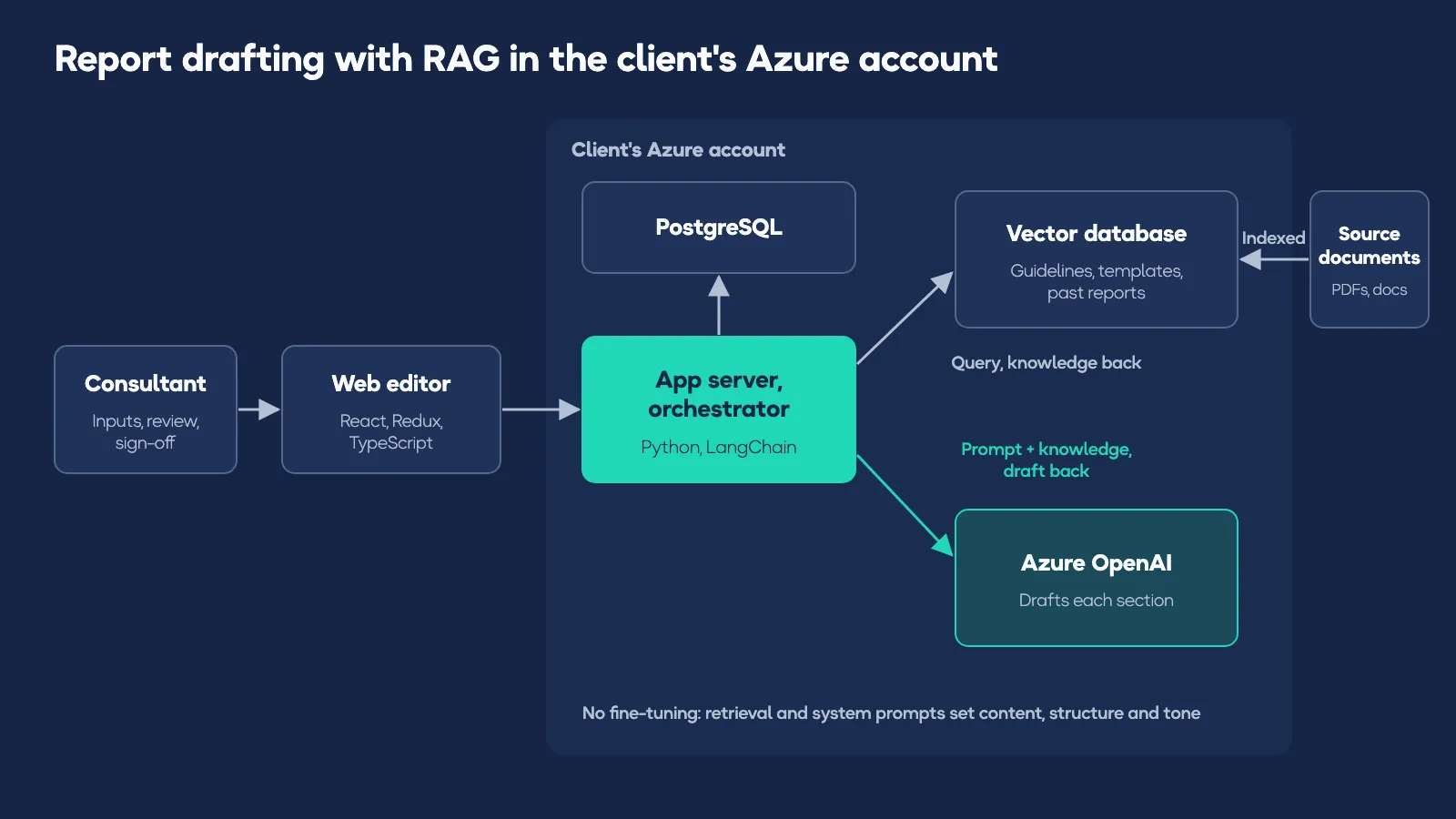
An R&D tax consulting firm wrote every report by hand, so its output was capped by its writers' hours. The reports carry its customers' confidential project details, and the data had to stay under the firm's control. In five months our team delivered a generative AI system that drafts its R&D tax reports and deployed it into the firm's own Azure account, where it calls Azure OpenAI.

A consultant starts with everything the firm holds on the project: client notes, files, web sources and the brief. Classifiers place the project in its field of science or technology, and mappings link it to the guidelines, templates and past reports that apply. Those documents are indexed in a vector database. For each section of the report, a Python orchestrator on LangChain retrieves the relevant passages and sends them to the model with that section's system prompt, which sets the structure and the firm's tone.

No model was fine-tuned, so the firm's knowledge stays in its documents, where it can be updated. What the system produces is a draft. A panel of AI reviewers reads it first and checks whether the project shows the advance in science or technology and the uncertainty the claim rests on, whether any statement is missing from the client's documents, and whether every template section is there. The draft then opens in a web editor section by section, where a consultant edits the text, regenerates a section, gives the AI a suggestion to work in or opens the source behind a statement. No draft is relied on until a person has reviewed it, and a consultant signs off each report, reviewing a draft where they used to write the whole text by hand.

Diagram: a consultant's editor, a LangChain orchestrator, a vector database and Azure OpenAI in the client's Azure accountDiagram: a consultant's editor, a LangChain orchestrator, a vector database and Azure OpenAI in the client's Azure account

OUR CLIENT'S RESULTS

<3 min

To generate a report draft

~$2

AI running cost per report

20

Man-hours saved per report

550+

Reports a year through the workflow

Have a use case in mind?

Describe what the system should do and where its data lives, and we'll suggest which approach to try first and where it is likely to fail.

PROCESS

How a prototype becomes a production system

A prototype answers the ten questions its builders tried, and production meets the thousand they didn't. The five steps close that gap in order, starting with your data and ending with real users' questions sampled after launch.

  1. STEP 1

    Discovery phase

    When a build starts with discovery, we review the use case, your data and your systems. Where you can share data under the NDA, we try the riskiest part on a sample of it.

    Usually 2–4 weeks

  2. STEP 2

    Agree how results are judged

    Before the build, we agree a test set and a go-live bar. A good bar covers retrieval of the right passage, answers that keep to it, a decline when the documents are silent, and cost per answer.

  3. STEP 3

    Build in Agile sprints

    A demo every two weeks shows where the work stands. Per-call cost tracking, with limits and alerts, is set up as part of the build.

  4. STEP 4

    Staged release into your systems

    The system goes live in stages, and at first a person reviews the outputs it is unsure about.

  5. STEP 5

    Watching answer quality after launch

    Our data scientists sample what real users ask and how the system answers, and watch for drift as your documents and the model change.

TECHNOLOGIES

Generative AI tools our engineers work with

OpenAI API

Anthropic Claude

Google Gemini

Mistral

Llama

Amazon Bedrock

Azure OpenAI

Google Vertex AI

LangChain

LlamaIndex

pgvector

Langfuse

LangSmith

Ragas

Python

SECURITY AND DATA

How is your data protected in an AI build?

Retrieval that respects permissions

An assistant that searches your documents has to respect the same permissions as the person asking. If a user can't open a file, the assistant must not quote it, summarize it or hint at what it says, and one customer's documents must never surface in another customer's answer. So the access rules have to travel into the search index with the passages, and it is worth asking for a restricted file by name, and then around it, before launch.

Instructions hidden in documents

Prompt injection is text planted in a document, an email or a chat message that tries to give the model new orders. Filters catch some of it and miss the rest, so the design should limit what the system can reach: only the documents it needs, guardrails on its output, and no action taken on an answer without a check.

Where our systems are hosted

Systems we control are hosted in the EU, and we work under GDPR as an EU company. Your repositories, cloud accounts and the data in them stay wherever you keep them. A DPA is part of the engagement whenever we handle your data.

Access to your systems

Our engineers work through named accounts you issue, with only the access their role needs, model accounts included. All of it is removed when an engineer leaves the engagement.

Illustration of a padlock over a document index, with separate access keys for different usersIllustration of a padlock over a document index, with separate access keys for different users

BEFORE YOU CHOOSE A VENDOR

Questions to put to any generative AI vendor

Abstract 3D illustration of four stacked white slabs like a checklist, two of them marked with ticksAbstract 3D illustration of four stacked white slabs like a checklist, two of them marked with ticks

Who will write the code?

Engineers who average 7 years of experience, 80%+ of them senior-level or above. For AI roles our technical assessment covers RAG design, latency and cost trade-offs and model drift.

Will they say when AI is the wrong call?

Ours will, in discovery, before you fund the work. Sometimes the better answer is an off-the-shelf tool, a cleanup of your data, or no generative AI at all.

What have they actually shipped?

Most of our AI work sits under client NDAs, so few AI cases are published. The generative AI one is the R&D tax report system described on this page.

Where does the work start?

Discovery fits an unclear idea or architecture, a proof of concept a risky assumption. A proof of concept usually takes up to a month and a proof of value up to two. Neither needs discovery first.

HOW WE WORK

Engagement models and terms

Project delivery

We deliver an agreed scope end to end: plan, team, milestones, QA and release. You make the product decisions and accept each milestone.

Fixed price per milestone after discovery, or time and materials against an estimate.

  • Scope changes go through change requests.
  • On fixed-price projects, a warranty period agreed in the contract, usually 30–60 days.

Discovery phase

A short phase before a build: requirements and backlog, architecture, an estimate and a delivery plan.

Fixed price, usually 2–4 weeks.

  • The outputs stay with you whether or not the build continues with us.

Staff augmentation

Our engineers join your team and work in your process and tools. You manage them; we source, vet and contract them.

Hourly rate per engineer by role and seniority, invoiced monthly.

  • If an engineer isn't the right fit, we replace them within 14 days at no extra cost.
  • Knowledge transfer to the replacement engineer isn't billed.
  • There is no free trial period.
  • 30 days' notice to take an engineer off or end the engagement, with no minimum term beyond it.
  • Out-of-hours on-call only if agreed with you; we set its hours and billing together.
  • After two years, moving an engineer onto your own staff is something we can discuss.

Whichever model you choose

  • We reply to an inquiry from the contact form within 24 hours.
  • We sign an NDA before work starts, and IP passes to you on payment.

PEOPLE

Engineers for your own team

If your own team will build the system, add AI engineers for LLM work through staff augmentation. We present matched candidates within 7 days of your request, and you interview each one before anyone starts.

AI application engineers

They build LLM integrations, RAG pipelines and the evaluation around them, inside your codebase and your process.

If nobody on your team has built a RAG system yet, ask for a lead-level engineer to set the technical direction.

Plan a build that outlives its first model

"Models change every few months. Put yours behind one interface, keep your logic outside it, and a swap is a config change plus a check."

Dzmitry Kuchynski, Chief Operating Officer, Octalance

FAQ

Questions buyers ask before a generative AI build

What drives the cost of a generative AI build?

Six things move it most: how many use cases you start with, how clean and current your documents are, the systems it has to connect to (single sign-on, permissions, a CRM or help desk, a fallback for when the model provider is down), which model it calls and how often, how deep the testing goes, and the support you want after launch. Hosted model APIs usually bill per token, so your traffic sets the running cost. Two pieces of advice: decide what one answer may cost before the build starts, and pick the model per task, because the largest model is rarely needed for every step. After discovery, a build is priced at a fixed price per milestone, or as time and materials against an estimate.

Can the model run in our own cloud account?

Yes. The R&D tax report system on this page runs that way, on Azure OpenAI in the firm's own Azure account, and Amazon Bedrock and Google Vertex AI work on the same principle. One thing stays between you and the provider: the model service's data-retention settings are part of your agreement with that provider, so check them against your own policies before real data goes in.

What does the system do when the answer isn't in our documents?

It should say it can't find the answer and stop there, instead of filling the gap with a fluent guess. That behavior has to be built on purpose. Questions your documents don't cover belong in the testing from the start, next to the ones they do, and the prompts have to give the model explicit permission to come back empty-handed. Grounding only works when declining counts as a correct answer.

Is an AI agent part of a generative AI build?

Not unless you ask for one. A generative AI system answers questions and drafts text, and a person decides what to do with the result. If you want the system to act as well, say so in discovery, because approval points and tool limits are scoped as separate work.

Can we share our documents under an NDA before we commit?

Yes. On request we sign an NDA with you before you share project details. Where your data can be shared under it, discovery can try the riskiest part of the idea on a sample of your documents before you decide on a build. Not every company can share data that early, and discovery doesn't depend on it.

Does the EU AI Act apply to what you build for us?

It can, wherever your company is based, if the system is offered in the EU or its output is used there. The Act, Regulation (EU) 2024/1689, sets duties by use case. A few practices are banned outright, high-risk uses such as screening job candidates or scoring credit carry the heaviest obligations, and chatbots and AI-generated content come with transparency duties, such as telling people they are dealing with an AI. Whether your use case counts as high-risk is a question for your legal counsel.