Inmon: top-down warehouse
One normalized enterprise warehouse comes first, and department data marts are derived from it.
Worth the longer first phase when many sources must agree on one record of the customer or the order.


Our data warehouse development services start from the reports you need and work back to the model. Client cases cover Redshift, Airflow and dbt.
STARTING POINTS
Reports come from spreadsheets or straight from production databases, and finance and sales each bring their own number to the meeting. Discovery maps which reports matter, which sources feed them and how fresh the data has to be. Then we recommend a model and a platform, and build it in sprints.
Queries crawl as data piles up, loads fail and someone reruns them by hand. A global mobile software developer reached the point where a day's data couldn't be downloaded within the day. Often the platform is fine and the trouble is in how the tables and loads were designed. An assessment shows which.
The warehouse exists, but data reaches it late, by hand or not at all. A professional education company had an Amazon Redshift warehouse and needed pipelines to populate it. We chose Fivetran for ingestion and dbt for transformation and modeling, then added validation and monitoring to the ETL.
The current platform costs too much, no longer scales or sits on a cloud you have left. We design the target warehouse on Snowflake, BigQuery, Databricks or Redshift, or on Azure in Synapse or Fabric. The other half is migrating to a new warehouse safely, with source-to-target mapping, validation and a way back if the cutover fails.
Your data lead knows what to build, and the backlog is longer than the team. We place data engineers who join your sprints, work in your repositories and take reviews from your lead. We present matched candidates within 7 days of your request. 80%+ of our engineers are senior-level or above.
DATA WAREHOUSING METHODS
A data warehouse build pulls your source systems through ETL or ELT pipelines into one modeled store, puts BI on top and keeps history your apps overwrite. The model is the hard part. Inmon, Kimball and Data Vault start from different places, and your reports decide which fits.
All three feed OLAP-style reporting, the slicing and aggregating most dashboards rely on, and many warehouses mix them. We settle the choice in discovery, as the core of data modeling for the warehouse, by how often your sources change and how soon reports are due.
One normalized enterprise warehouse comes first, and department data marts are derived from it.
Worth the longer first phase when many sources must agree on one record of the customer or the order.
Star schemas, one business process at a time, joined through shared dimensions such as customer and date.
Reports reach users sooner, which is why BI-heavy teams usually start here.


Hubs, links and satellites hold business keys, relationships and history apart, so a new source slots in without a redesign.
For a company with a handful of stable sources it is more machinery than the job needs. Star schemas usually sit on top for reporting.


PLATFORMS
Pick the cloud first, then the billing model. Most companies already run on one cloud, and the warehouse that lives there is the easiest to connect. Amazon Redshift, the platform in two of our cases, runs on AWS as provisioned clusters or Redshift Serverless. BigQuery is Google Cloud's serverless warehouse and can bill by the data each query scans. On Azure, Microsoft Fabric is where Microsoft's current warehouse sits, and Synapse Analytics is common in what already runs there.
Snowflake and Databricks sit across clouds. A Snowflake warehouse keeps storage and compute separate, so each scales and bills on its own, and it runs on AWS, Azure and Google Cloud. Databricks is a lakehouse, where warehouse SQL runs on the same files as data science and Spark jobs.
A platform that bills compute by use rewards a tidy model, because a badly joined table is paid for on every query that touches it. We work as an independent team with no vendor partnership, so our recommendation follows your cloud and your bill. Where the warehouse is one part of a larger platform, data architecture design comes first. Reporting sits on top, in Power BI or Tableau.
WHAT IT COSTS
Four things set the engineering effort, and none of them is the platform's logo. The platform vendor bills its own compute and storage separately from the engineering work. Each of the four grows with what you ask the warehouse to do.
Each source needs its own extraction, mapping and checks. A SaaS connector you can rent costs far less to bring in than an old ERP full of free-text fields.


Years of history grow storage and stretch every full reload. Decide early what needs daily detail and what can be summarized.


A handful of fact tables builds quickly. Dozens of entities with conformed dimensions and tracked history take far longer to design and test.


Every new dashboard asks the model for another metric, defined once and tested. The more BI on top of the warehouse you want, the more model work sits under it.


CASE STUDIES
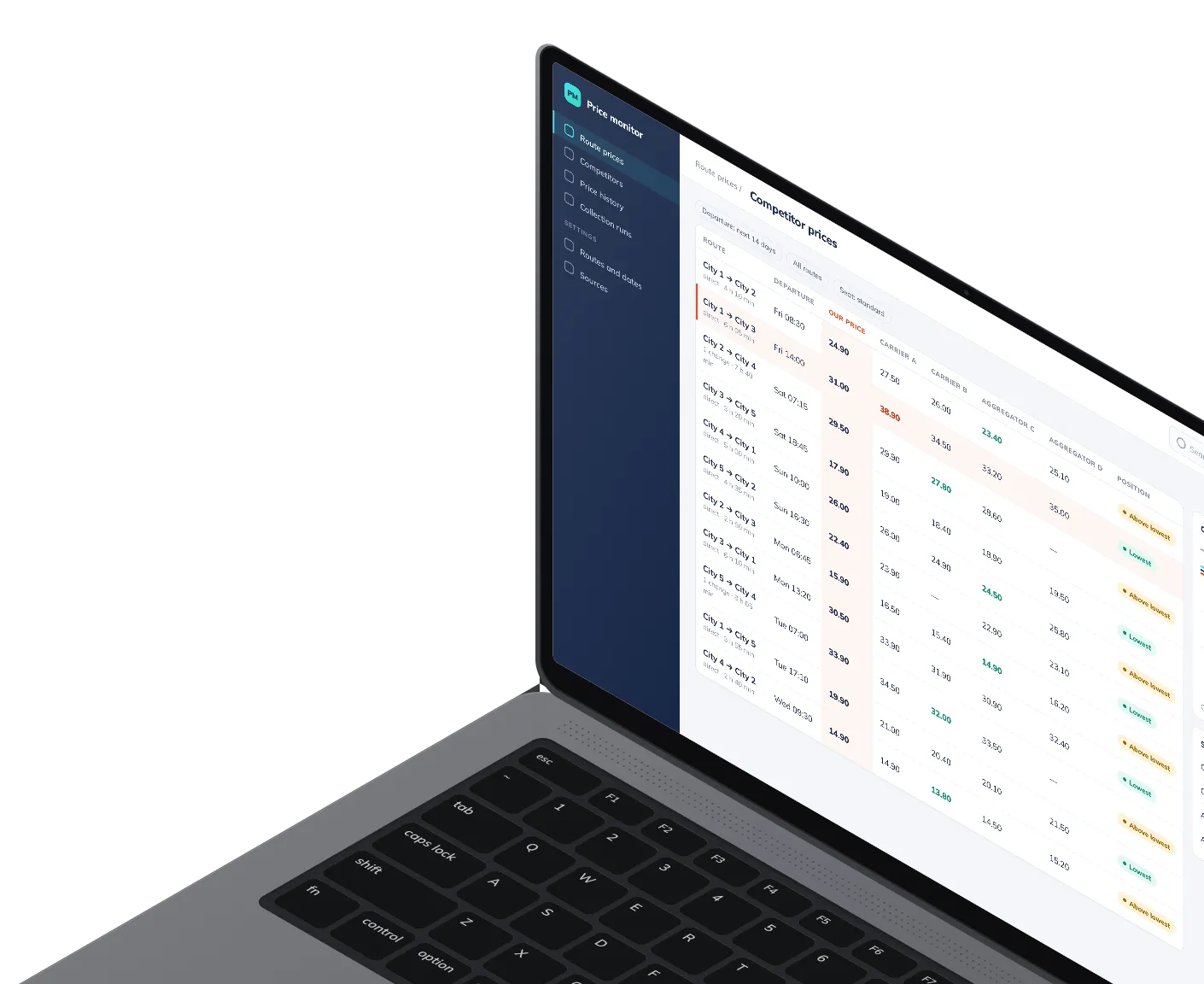
Three of these were new builds: a fintech company's warehouse, a Web3 platform's external warehouse and a bus travel company's store of competitor prices. The other three already had a warehouse. The work went into the tables, the loads and the pipelines.
Each figure on these cards is that client's own result, as its case study reports it. Clients stay anonymous under a non-disclosure agreement, so each card shows the industry and the stack instead of a name and a logo.
Tell us what your reports run on today and where they break. The usual first step is a discovery phase that ends in a plan.

PROCESS
Every warehouse in our data engineering practice goes through five steps, and the first is the cheapest place to change your mind, before any pipeline exists. The team works remotely, and for a US client we arrange 4+ hours of daily overlap with the West Coast.

STEP 1
We read your sources, reporting requirements and current architecture, then hand over a platform recommendation, an estimate and a delivery plan.
Usually 2–4 weeks

STEP 2
Layers, model and pipelines are designed together. You receive model diagrams, scripts, a data dictionary and source-to-target mapping.

STEP 3
Pipelines, models and reports are built sprint by sprint, with validation inside the pipelines, a demo after each sprint and the work tracked in Jira.

STEP 4
Your team gets a walkthrough of each report and the data dictionary behind it, then takes over the pipelines, the model and the documentation.

STEP 5
Fixes and small improvements by priority, in CET/CEST business hours or shifted to your day. Usually a retainer plus hours or tickets, with response times agreed in your support contract.
HOW WE WORK
We deliver an agreed scope end to end: plan, team, milestones, QA and release. You make the product decisions and accept each milestone.
Fixed price per milestone after discovery, or time and materials against an estimate.
Our engineers join your team and work in your process and tools. You manage them; we source, vet and contract them.
Hourly rate per engineer by role and seniority, invoiced monthly.
A short phase before a build: requirements and backlog, architecture, an estimate and a delivery plan.
Fixed price, usually 2–4 weeks.

Before we name a platform, we ask which reports your people trust and which they rebuild in a spreadsheet. We start from those.

Dzmitry Kuchynski, Chief Operating Officer, Octalance
FAQ
If the platform still fits your cloud and your budget, fix what sits underneath it first: the model, the pipelines and the cluster settings. That usually costs less than a move, and, planned well, your reports can keep running while the work happens. There is a middle path too. Stay on the same platform and change how it is set up, such as a different cluster or rarely read history moved to cheaper storage that can still be queried. When the platform itself no longer fits, a move is the better call. Discovery prices the options side by side before you commit.
It depends on the workload. If the job is reporting on structured data from your business systems, a warehouse does it with less to run. If data scientists also need raw files, logs or event streams next to those reports, a lakehouse keeps both on one copy of the data. Databricks is a lakehouse platform with SQL warehouses for the reporting side. Plenty of teams run a warehouse for finance reporting and a lake for machine learning, and that is a sound setup.
You own it. IP passes to you on payment, and the code usually lives in your repositories. Our engineers work through named accounts you issue in your own IAM or SSO, covering the warehouse, the cloud account and the source systems, with only the access their role needs. All of it is removed when they leave the engagement. Systems we control are hosted in the EU; your own repositories and cloud stay wherever you keep them. We work under GDPR as an EU company, and if you need your engineers in a specific location, we staff to that requirement. Where we handle your data, a data processing agreement is part of the engagement.
Yes. It starts with an audit. We read the code, its dependencies and how it is deployed and released, and note missing tests and documentation. You get a written list of findings with our recommendation on what to fix first. A short handover follows, covering access, environments, runbooks and the previous team's walkthrough where one is available. From there you decide whether we fix it, run it, or both.
Yes. Data engineers can join your team under staff augmentation, and your lead sets the priorities. Before you meet a candidate, they have passed our technical assessment, which for a data engineer means SQL on large tables, a data modeling task and a pipeline design task. You interview them yourself and can turn anyone down. The terms are in the section Engagement models and terms.
Validation runs inside the pipelines, and monitoring watches the loads. On the professional education company's warehouse, validation flags broken or late data before it reaches a dashboard. On a move between platforms, the old and new warehouses run in parallel, and we reconcile row counts and checksums before cutover.
There is no published Snowflake case yet. On Databricks, we rebuilt a logistics company's demand forecasting system, with Spark ML on Azure. Our warehouse cases on this page run on Redshift, Redshift Spectrum, Athena, S3, AWS Glue Studio, Vertica and PostgreSQL, with Airflow, dbt and Fivetran, and the team includes certified Snowflake and Databricks engineers. The fintech warehouse on Vertica was built so it could move later. Its model is plain SQL and its transformation logic sits outside the platform, so a move means repointing the pipelines rather than rewriting them. On either platform we take on new builds, migrations from a legacy warehouse or Hadoop, dbt pipelines, and cost and performance tuning.