Refactor the existing code
Suits a system whose design still holds but whose code has aged. We tidy the structure and leave what it does unchanged.
Safe when tests pin down today's behavior. Where there are none, we write them first.


Our application modernization services take one system at a time, own or inherited. One lending client's case reports 67% faster partner rollout.
LEGACY MODERNIZATION
Modernizing an application means changing the code or design of software your business still runs on, so it can change again. Teams call it legacy system modernization when that software is old and hard to change. The approach is chosen for each part of the system, after we understand what it does today.
Age alone doesn't make a system legacy. The cost of every change does. On our projects it was a product information system on Adobe Flex, a stack we would not choose for new work, and a lending platform where each new partner's scoring rules meant developers editing code by hand. Every workaround like that adds technical debt. The fix is rarely one big rewrite, because usually one part blocks change and the parts around it can stay.
Here, legacy modernization means changing the application itself, as part of our full-service software development. If the goal is moving legacy workloads to the cloud, that is a separate service. You can modernize without it, and the system can stay where it runs today.

APPROACHES
A legacy estate rarely needs one answer. A billing module may only need refactoring, while the monolith next to it needs re-architecture and a home-grown reporting tool is better replaced. We choose per system, and the smallest change that works is usually the right one.
Cloud-migration lists such as the "7 Rs" add rehosting, moving a system to new servers or a cloud host with its code unchanged. That belongs under cloud migration. The six here are about the application itself, from tidying its code to switching it off.
Suits a system whose design still holds but whose code has aged. We tidy the structure and leave what it does unchanged.
Safe when tests pin down today's behavior. Where there are none, we write them first.
Working code on a framework, language version or database that no longer gets updates moves to a supported one, as with a call center console moved off Java 7 and AngularJS.
We analyze the code first and sort what can move with light changes, such as renames and library updates, from the modules that need rework, because an upgrade alone isn't always enough.


When the design itself blocks change, as in a monolith where every release touches everything. Re-architecture splits it into parts that can change on their own.
With the strangler pattern, new services take over from the old system piece by piece while it stays in use.


The system still does the right job, but its code is past saving. We keep the scope and the business rules and write the code again.
The largest effort of the six. The old system keeps running until the new one takes over.


If the job it does is no longer specific to your business, an off-the-shelf product or a SaaS tool can take it over.
The risk moves into data migration and into changing your processes to fit the product.


Some systems are stable and rarely need to change. Others have lost their job and can be switched off. Leaving a system alone is a decision too, and often the right one.


Tell us what the system does and which part blocks change today. We will suggest where discovery should start.

PROCESS
If nobody can say what the system does today, we start with discovery work, which ends in an estimate, a delivery plan and the risks. Then we deliver the modernization as a project, in sprints against that plan.

STEP 1
A business analyst maps what the system does and what already exists, and an architect draws the target architecture. You give us the people who know it and access to the system.

STEP 2
We agree with you which parts to refactor, re-platform, re-architect, rebuild, replace or leave alone, and in what order.

STEP 3
The team works in Agile sprints, with a demo after each, so you see a part working before it replaces anything.

STEP 4
Users and data move to each new part, with a fallback ready if the switch fails. If the design permits and your requirements agree, the cut-over goes part by part.
CASE STUDIES
For a German company, we moved the front end of its product information system off Adobe Flex to Angular. Old and new ran side by side, so there was no downtime. The case study reports 40% less manual effort preparing campaigns.
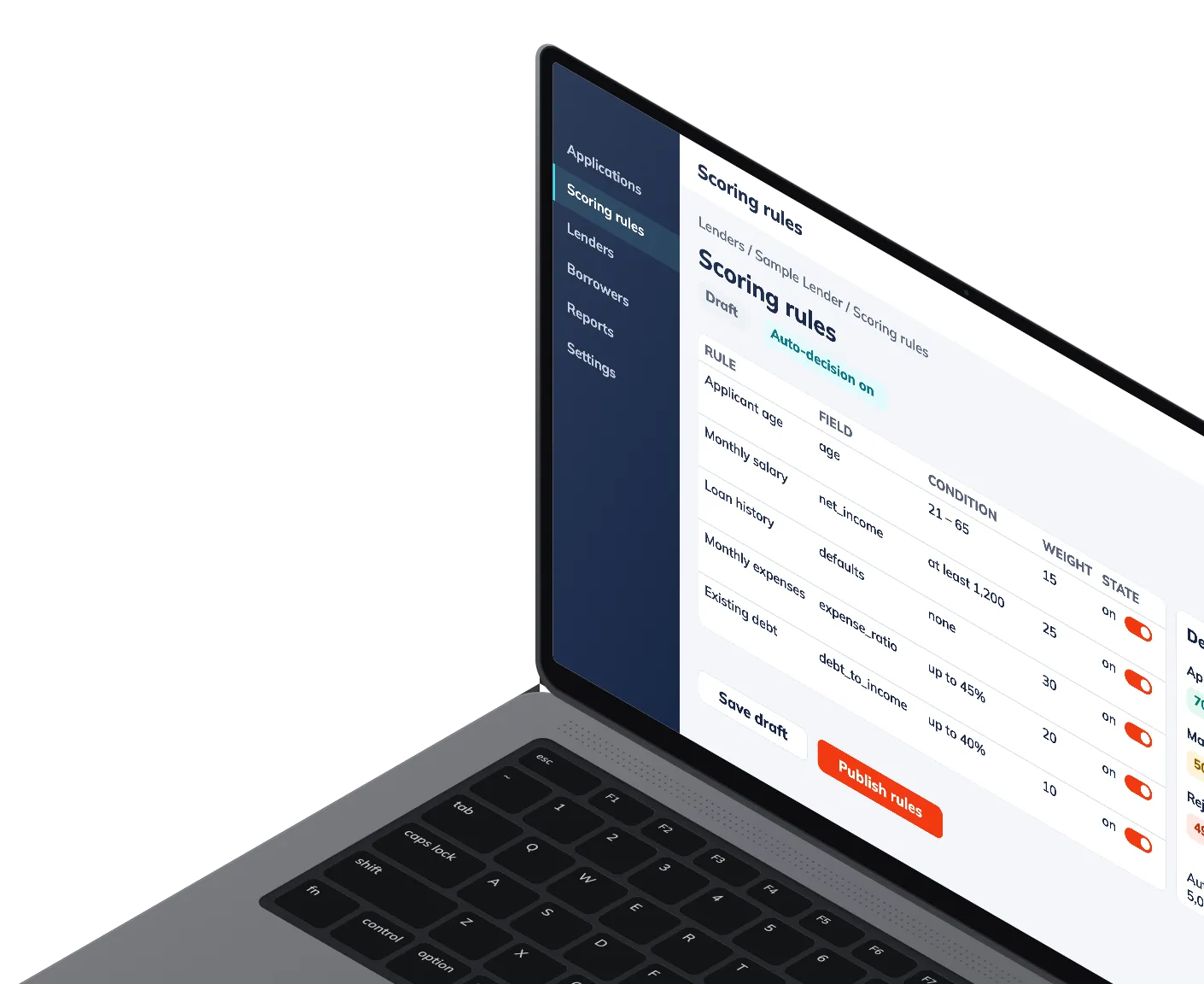
For an Estonian loan management software provider, we re-architected the scoring module, moving its rules from the code into the interface so staff set them without developers, and split the monolith into microservices. The case: 67% faster partner rollout and 75% faster application processing.
CODE BUILT ELSEWHERE
We start by reading the code you inherited, its dependencies and how it is deployed and released, and we note where tests and documentation are missing. You get a written findings list with our recommendation on what to fix first. On inherited code that list sets the plan, so nobody starts a rewrite just to avoid reading the old code.
A short handover follows as a defined phase: access, environments, runbooks, and the previous team's walkthrough where one is available. It is the step teams skip when they are in a hurry, and the one they miss most later.
While the system is in use, we keep it stable with fixes, updates and small improvements worked by priority, plus preventive work such as adding missing tests. As parts are modernized, the work turns into support for the modernized system.
The parts that slow every release get the approach that fits each, and the rest stay in support. If your system runs on Java, .NET or Python and you would rather extend your own team than hand the work over, we can staff engineers who know your legacy stack to join it. Company-wide, 80%+ of our developers are senior-level or above, with 7 years of experience on average.
HOW WE WORK
We deliver an agreed scope end to end: plan, team, milestones, QA and release. You make the product decisions and accept each milestone.
Fixed price per milestone after discovery, or time and materials against an estimate.
A short phase before a build: requirements and backlog, architecture, an estimate and a delivery plan.
Fixed price, usually 2–4 weeks.
We keep a live product stable and work through fixes, updates and small improvements by priority.
Usually a retainer plus hours or tickets by priority, agreed per client.

"An old system is usually one bad part holding up several good ones. Fix that part and the rest can stay."

Dzmitry Kuchynski, Chief Operating Officer, Octalance
FAQ
Ask two things about the system. Is the job it does still specific to your business? And is the logic at its core still right, however tangled the code around it? Yes to both points to modernizing. A product that now does the same job points to replacing it. A job that still matters, in code nobody can safely change, points to a rebuild.
Often, if the system has natural seams where new parts can take over one job at a time. It gets harder when everything shares one database, because the data usually has to be separated before the jobs can be, and that sets the order of the work.
Yes, even when the previous team is gone, because the audit works from the code itself. While we audit and support it, our engineers work through named accounts you issue in your own systems, limited to their role, and their access is removed when they leave the engagement.
When you run a discovery phase, you get the number at its end, as its estimate. On time and materials, the bi-weekly demos then show where the work stands against it. If it looks like passing it, we say so at the demo with the reason and a revised estimate, and you decide whether to continue, cut scope or stop. We don't go past the estimate without your approval. On fixed price, a change in scope becomes a change request.
No. Moving the same code to a new host changes where it runs, and a system that was hard to change on your own servers stays hard to change in the cloud. Modernizing changes the code or the design. Where you need both, the order depends on the system: sometimes the move is easier once a part is restructured, sometimes the other way round.
Yes, within your rules. Old code often holds business logic a company would rather keep away from outside services, so we use only the tools and accounts you approve, and nothing goes to a tool you haven't allowed. Code an AI tool writes gets two reviews before merge, first by another AI agent and then by one of our engineers, and our testers treat it like any other change.
You do. IP passes to you on payment, and the code usually lives in your own repositories, sometimes in ours. Where we handle your data, a DPA is part of the engagement.