Telecommunications
50+ service management workflows moved into Camunda in monthly releases
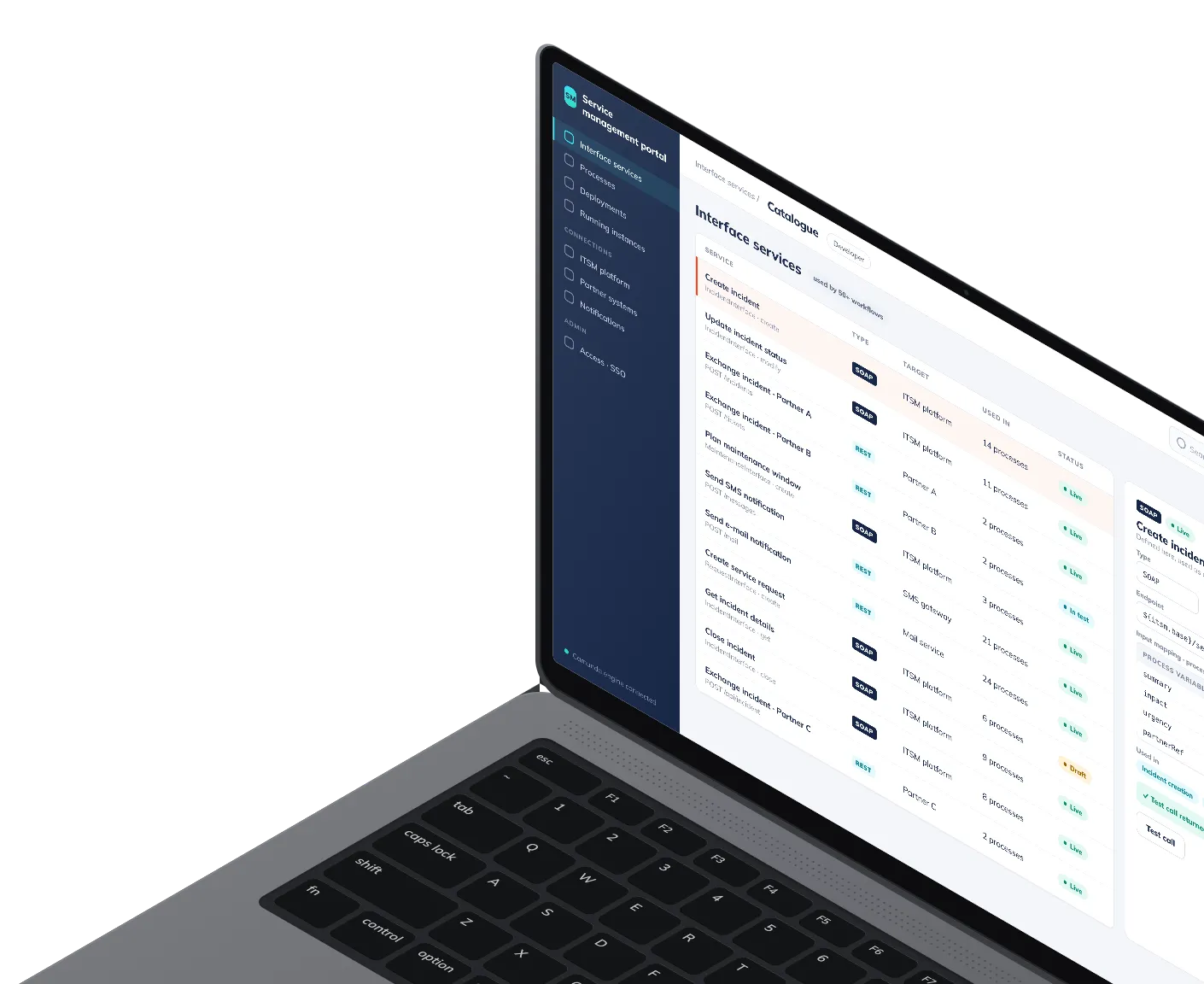
A low-code portal lets developers add integrations without coding them into the client's ITSM platform, which keeps the records while Camunda runs the logic
Custom software development
2 years
Who we worked with
Telecommunications provider
The client is a telecommunications provider. Its enterprise service management unit ran a standard ITSM platform, extended so heavily with custom code that every upgrade was risky, slow and expensive. We took the workflow logic out of it and into Camunda.
What we did
Taking the logic out of the ITSM platform
A standard platform, customized until upgrades hurt
The client ran a standard ITSM platform, BMC Helix (formerly Remedy), connected to many subsystems and extended heavily with custom code. Faults were hard to isolate, and much of the work was still manual or only partly automated.
A portal where integrations are configured
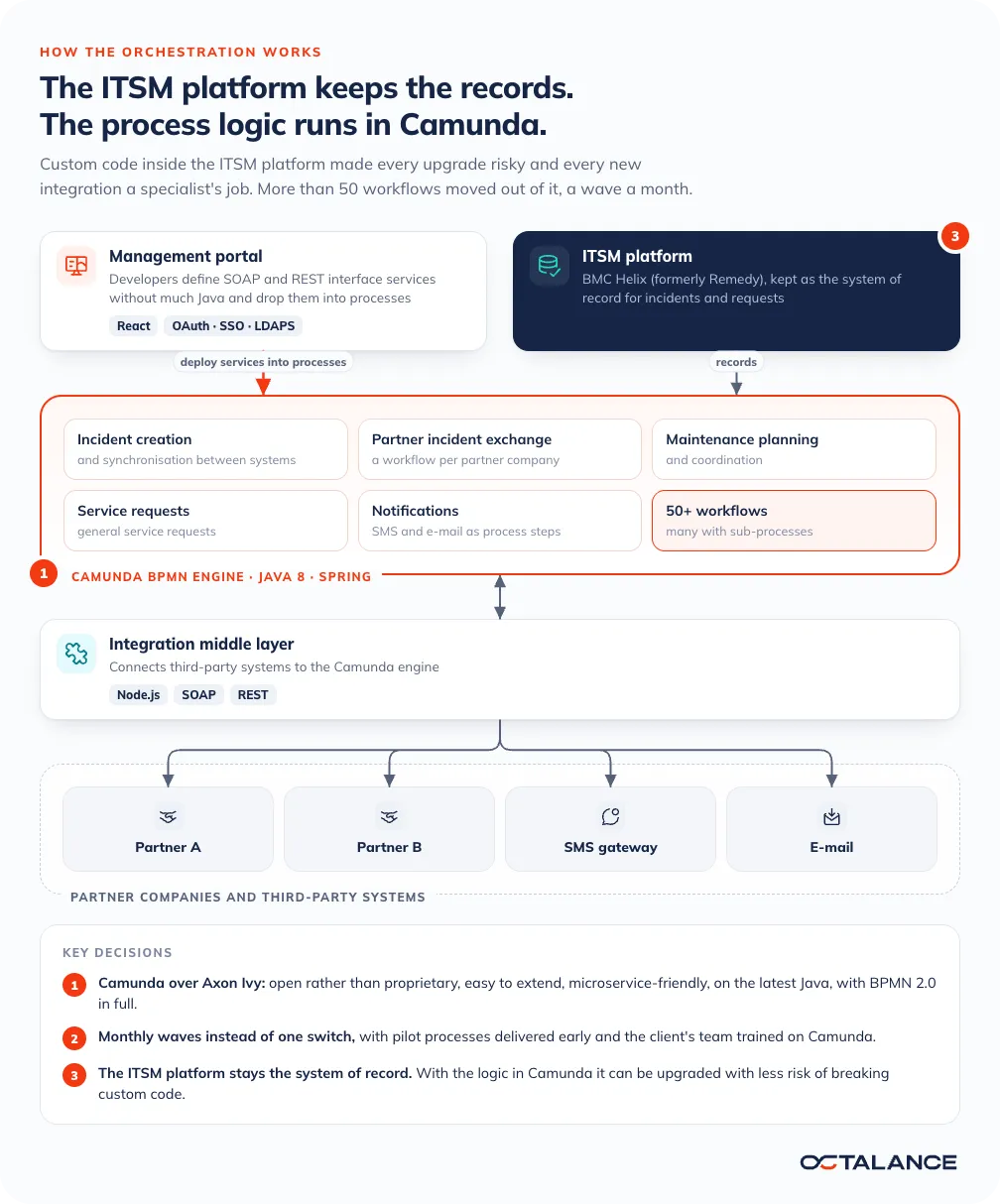
We designed and built a low-code management portal. In the React portal, developers define SOAP and REST interface services without writing much Java, then drop them straight into Camunda processes, where they run. A Node.js middle layer connects third-party systems to the engine.
What moved into Camunda
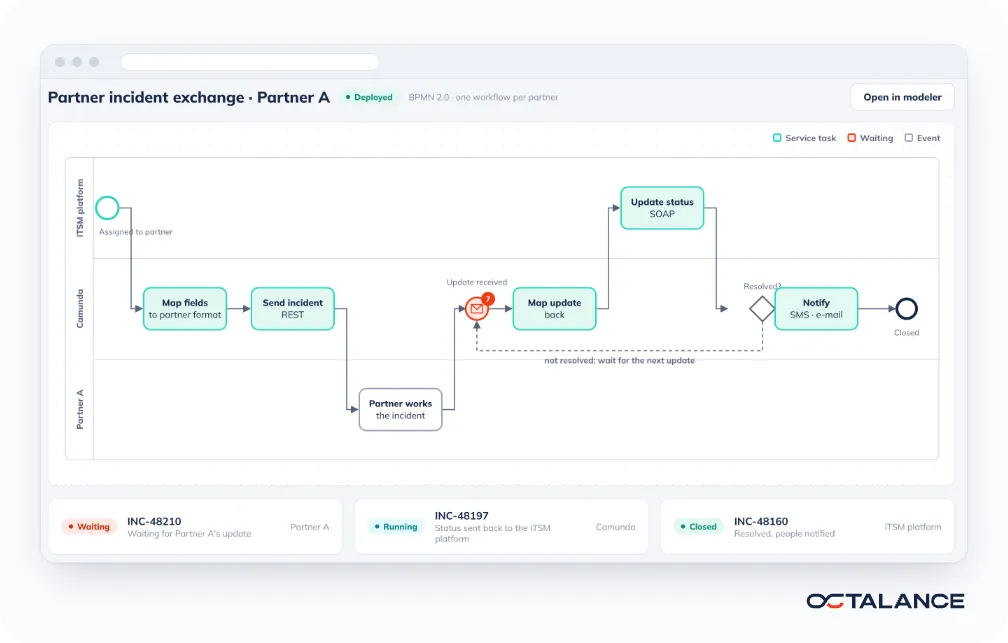
More than 50 workflows moved, many with sub-processes of their own. One set creates incidents and keeps them in sync between systems. Another exchanges incident requests with partner companies, with a workflow for each partner. Others plan and coordinate maintenance, handle general service requests and send SMS and email notifications. Routine steps such as passing an incident to a partner now run on their own.
Architecture, training and pilots
We had built Camunda workflows behind a React portal before, for an IT services company's internal back office. We planned the architecture of the Camunda environment, trained the client's team in Camunda practice and delivered pilot processes early to prove the approach. The portal works with OAuth, SSO and LDAPS.
What the client has now
A new integration used to take weeks, because a specialist had to code it inside the ITSM platform. Now a developer configures it in the portal and it takes days, so new developers get up to speed faster. With the logic moved into Camunda, the ITSM platform can be upgraded with less risk of breaking custom logic. Logic kept apart from the platform also limits how far an error can spread.
Why it is built this way
Where the logic should live
Every rule written inside an ITSM platform is one more thing its next upgrade can break.
Camunda as the process engine
Camunda is open, easy to extend and suits a microservice architecture.
A delivery every month
We moved the workflows in monthly waves. One big switch would have put every workflow at risk on the same day. Each release brought a set of them into Camunda and retired the old way of running them, so the client had working automation early. Camunda's test support covered parts of each workflow, and subject-matter experts tested the full flows by hand.
Records in the platform, logic in Camunda
The ITSM platform became a system of record, with the logic in Camunda. Each workflow there is a BPMN diagram, and the portal shows how processes flow.
Scope of the program
50+
Workflows moved into Camunda
2 years
Program, with a delivery every month
The stack
Camunda, React, Java and Node.js around BMC Helix
Camunda BPMN engine
React
Java 8
Spring Framework
JPA
JAX-RS
EasyREST
Node.js
SOAP
REST
OAuth
SSO
LDAPS
BMC Helix (Remedy)
Business logic buried in your ITSM platform?
Tell us which workflows live inside your ITSM platform today and what its last upgrade cost you. We reply within 24 hours.

Case studies