CI/CD and release automation
Every change tested, built and deployed one way in GitHub Actions, GitLab CI, Jenkins or Azure DevOps, with Bash or Python for the glue every pipeline needs, and a rollback when health checks fail.


Releases waiting on one person? Hire DevOps engineers tested on CI/CD, Terraform and Kubernetes, presented within 7 days of your request.


WHICH ROLE
Four roles we staff, told apart by what is going wrong
Hire a DevOps engineer when only one person can deploy, when test and production no longer match, or when nobody can say what the cloud bill pays for. They take over the path from commit to production: pipelines, infrastructure as code and the runtime. A long backlog is a capacity problem, and no DevOps hire shortens it.
They own how your services get built, deployed and run. The shared cloud foundations under those services belong to a platform engineer, and reliability targets to an SRE. In practice the lines blur, and a good DevOps engineer says so when work lands on the wrong desk.
This role works one layer down, on the accounts, networks, identity and shared services that other teams build on. In a small company one person often covers this and the DevOps work, and that is usually fine.
Here the focus is systems already serving users. The work is reliability targets, the alerts that page someone, and how incidents get run and reviewed afterward.
When most of your workload runs on one cloud, a specialist in it goes deeper. Our AWS specialists and Azure specialists include certified engineers, and they work in services such as EKS and IAM on AWS, or AKS and Microsoft Entra ID on Azure. Our DevOps engineers cover Google Cloud work too.


BY THE NUMBERS
7 years
Average experience, company-wide
80%+
Senior-level or above, company-wide
3
Vetting steps for every candidate
WHAT THEY OWN
They work in your repositories and cloud accounts, under your own change process, and the work falls into four areas: the release pipeline, infrastructure as code, containers with their monitoring, and the security and cost of the cloud they run in.
One engineer isn't always the right shape. When priorities keep moving and you want us to run the people, a managed DevOps team fits better. When you can describe the outcome, such as a new pipeline, DevOps work as a project does.
Every change tested, built and deployed one way in GitHub Actions, GitLab CI, Jenkins or Azure DevOps, with Bash or Python for the glue every pipeline needs, and a rollback when health checks fail.
Cloud resources in Terraform and server configuration in Ansible, so an environment can be rebuilt from the repository instead of from someone's memory.
If staging can't be rebuilt from code in a few hours, part of it still lives by hand.


Services packaged with Docker, deployed to Kubernetes with Helm charts and kept in step with Git by Argo CD.
Metrics and alerts in Prometheus and Grafana, with logs gathered in the ELK stack, OpenSearch or Loki.


Least-privilege IAM roles, private networking, and secrets in HashiCorp Vault or your cloud's secret manager. Pipelines deploy with short-lived credentials from the cloud, not keys saved in CI.
On cost, tags map spend to a team or service, resources get rightsized, and budgets alert someone before the month is over.


TECHNOLOGIES
CI/CD
Docker
Kubernetes
Terraform
AWS
Azure
Google Cloud
GitHub Actions
GitLab CI
Jenkins
Azure DevOps
Ansible
Helm
Argo CD
Prometheus
Grafana
INCIDENTS AND CHANGES
How incidents, on-call and changes work with our engineers
A DevOps hire hands someone the keys to production. Before the first day, settle two things: who answers when it breaks, and how a change gets there.
During their working hours, our DevOps engineers on a staff augmentation basis handle incidents inside your own incident process, with your alerting and your channels.
Joining your on-call rotation is something we agree with you per client. By default the engineer works CET/CEST business hours, and for a US client we shift the schedule toward yours. We don't run shifts, so a round-the-clock rota is not something one placed engineer can give you.
Infrastructure changes go in as code, through pull requests reviewed with their plan before anything is applied, and they follow your own change process. The engineer signs in through individual named accounts you issue in your own IAM or SSO, with only the access the role needs. All of it is removed when they leave the engagement.

Send the role, the seniority and the clouds you run on, and tell us which part of the release still happens by hand.

HOW WE VET
What happens before your shortlist, and questions you can ask yourself
Before anyone reaches your shortlist, a technical skills assessment tests what they claim, at the level they claim. A soft-skills evaluation covers their English, how they take feedback and how they work in a team. Then we analyze their job history. Seniority follows principles agreed in the market.
The DevOps part of the assessment is hands-on. The candidate designs or fixes a CI/CD pipeline, writes infrastructure as code in Terraform and troubleshoots a containerized service on Kubernetes. We judge each result on its security and its cost, because a pipeline that works and leaks a secret has still failed.
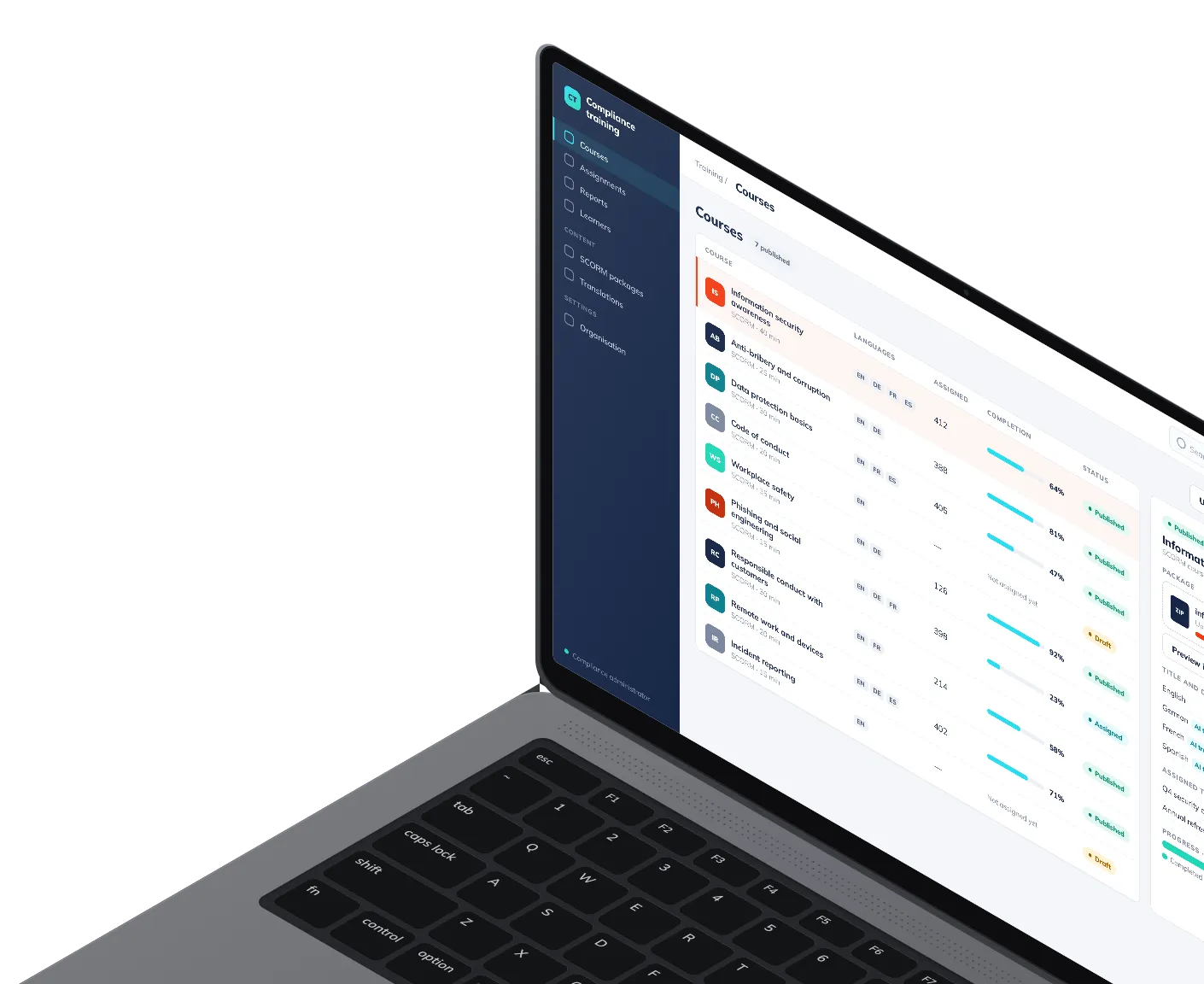
Some roles also get a live coding interview, and a background check runs only when a client asks for one. Under staff augmentation you interview every candidate yourself, and our technical interview can be part of your selection, with full visibility. To see delivered work, read how we set up the CI/CD pipelines and infrastructure as code for a compliance training module we built.
Ask about a pipeline they fixed and what had broken. Ask how they keep two people from changing the same Terraform state at once (state locking is the answer you want to hear), how they would debug a Kubernetes pod stuck restarting, and what they look at first when a cloud bill jumps. Strong candidates name what they would check before they name a tool.

CASE STUDIES
In each of these projects our team built the CI/CD, and on most of them the containers, the infrastructure as code or the monitoring as well. Most ran on AWS, one with Kubernetes on EKS inside the fintech client's own AWS account. The AdTech pipeline ran on Google Cloud.
Cost was part of the work too. The AdTech pipeline's cloud bill fell from $10 to $0.25 a day once the always-on server gave way to jobs that start on an event, and the client stayed with us for the next version of its platform.
PROCESS
Each duration is a usual time for that step. Our one commitment is to present matched candidates within 7 days of your request, and nobody starts before you have interviewed them. If you need other roles as well, there are more roles and technologies to hire.

STEP 1
We agree the seniority, the clouds and pipelines the engineer will work on, and the change process they will follow.
1 day

STEP 2
We shortlist candidates who have passed our vetting, the DevOps task included, and present them to you.
1–2 days

STEP 3
You interview the candidates you pick and decide who joins.
1 day

STEP 4
We handle the contracts and security setup, and your team grants the access the role needs.
1–2 days
HOW WE WORK
Our engineers join your team and work in your process and tools. You manage them; we source, vet and contract them.
Hourly rate per engineer by role and seniority, invoiced monthly.
An agreed team capacity that we manage. We coordinate delivery and handle the team's make-up. You set the priorities and own the backlog.
Per-engineer rates, or a fixed monthly fee for the agreed capacity.
We deliver an agreed scope end to end: plan, team, milestones, QA and release. You make the product decisions and accept each milestone.
Fixed price per milestone after discovery, or time and materials against an estimate.

"A good DevOps engineer makes the release boring. When nobody books an afternoon for a deploy any more, the hire has paid off."

Dzmitry Kuchynski, Chief Operating Officer, Octalance
FAQ
The price follows each engineer's role and seniority, and we agree it with you, so there is no rate card on this page. The levers you control are how many engineers you take on and how senior they are. A senior who will own the cluster and make the hard calls costs more than a mid-level engineer working under your lead, so match the level to the decisions the person will make. Paying senior rates for someone who will mostly follow a runbook is an easy mistake to make.
With manual or fragile releases, start with the DevOps engineer. Until changes ship reliably, an SRE has little worth measuring. An SRE earns their place once real production traffic meets reliability targets you intend to defend. A platform engineer comes later still, when several teams share the same infrastructure and keep solving the same problems separately.
The default working day is CET/CEST business hours, and EU and UK teams get the full day with no adjustment. For a US team we move the schedule and can arrange 4+ hours of daily overlap with the West Coast, and more with the East Coast. Work outside those hours happens only if we agree it with you.
Usually, yes, if it goes in small pieces. Anything new goes into code from the start. The existing resources are imported into Terraform state a group at a time, starting with the ones that change least. After each import the plan should show no changes. If it wants to modify something, the code doesn't match what is running yet, and nothing is applied until it does. Releases carry on throughout, because an import changes nothing in the cloud itself.
Under staff augmentation you do. The engineer works full-time for your team only, in your process and tools, and takes priorities from your lead. If nobody on your side can set that direction, a placed engineer tends to drift, and a project with us is the better fit: we run the delivery and you judge the result.
Yes. Our case studies show the pipelines, containers and infrastructure as code we set up for clients, and the compliance training module shows the most, with Docker and Terraform on AWS. More of our DevOps work sits under client NDAs, so we can confirm it exists but can't describe the projects or name the clients. For a placed engineer, the interview you run is still the better test, because it shows the person you would actually get.
You interview every candidate before anyone starts, and you can turn one down on the CV or on the interview. If a placed engineer still isn't the right fit, we replace them, and the details are in the Engagement models and terms section on this page. Say so early, because a mismatch is cheaper to fix in the second week than in the third month.