Professional services
Generative AI drafts R&D tax reports in under 3 minutes, for about $2 in AI cost per report
Every draft reads the firm's own guidelines and past reports inside its own Azure account, and a consultant edits it and signs the report off
Generative AI development
5 months
Who we worked with
R&D tax consulting firm
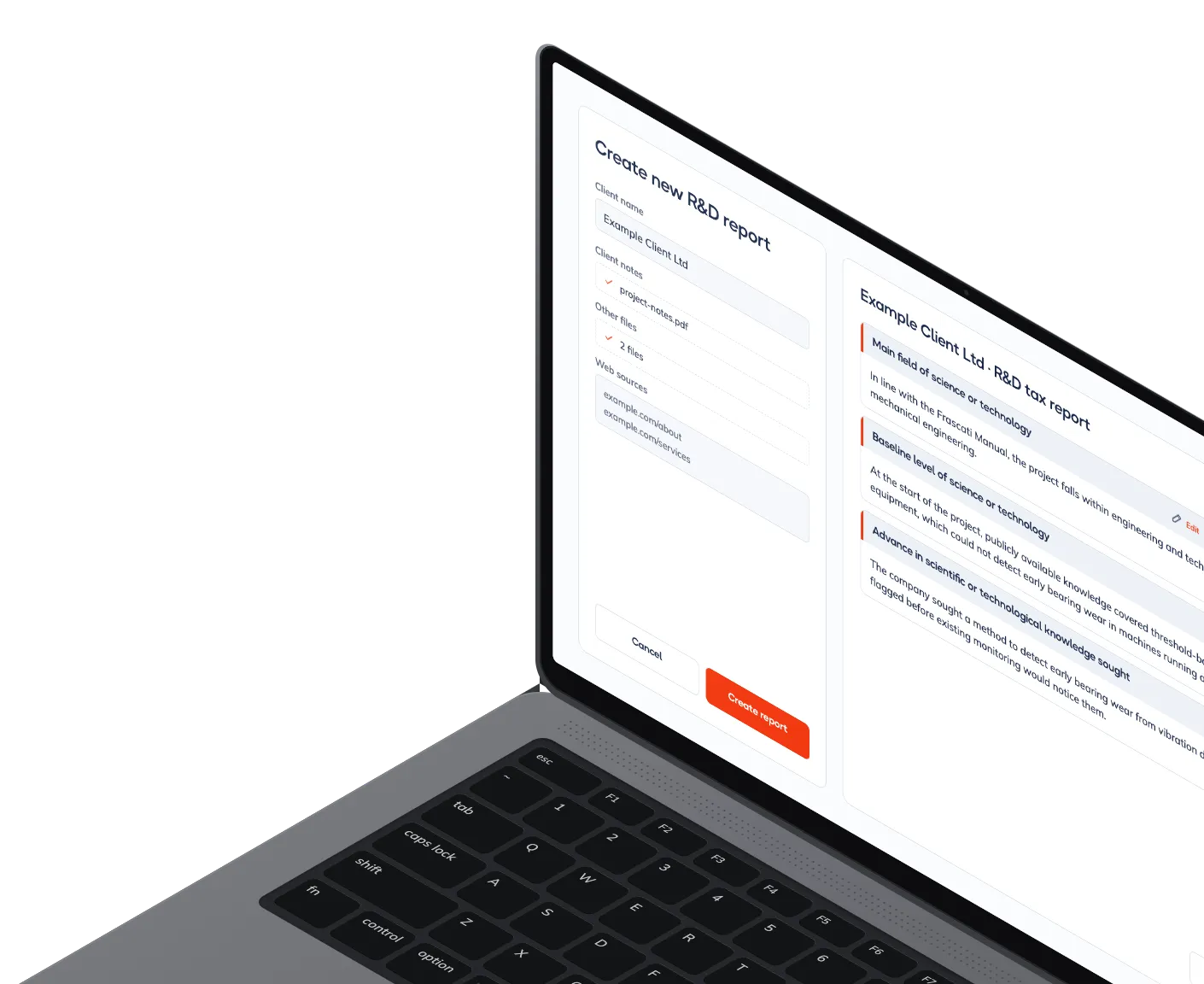
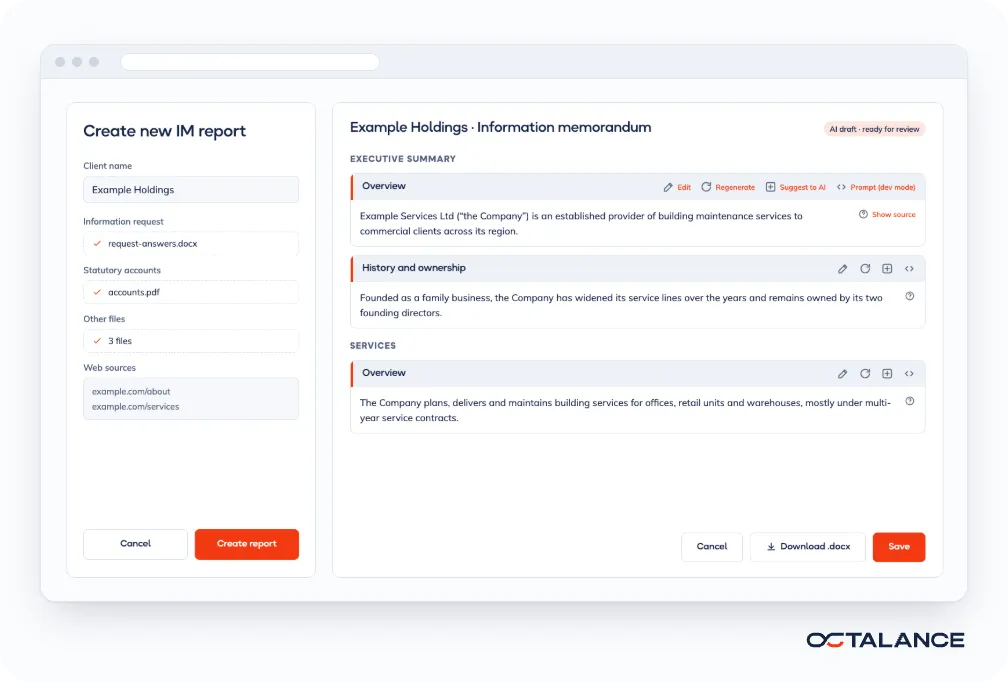
The client is an R&D tax consulting firm. It writes R&D tax reports and information memorandum reports for its customers, and it needed more of them, delivered faster, without hiring more writers.
What we did
From hand-written reports to drafts in minutes
Every report written by hand
Every report the firm delivered was written by hand. Each one took hours. That capped its output at what 20 specialist copywriters could write. The reports carry customers' confidential project details, so whatever we built had to keep that data in the firm's hands.
Both report types, from the firm's own documents
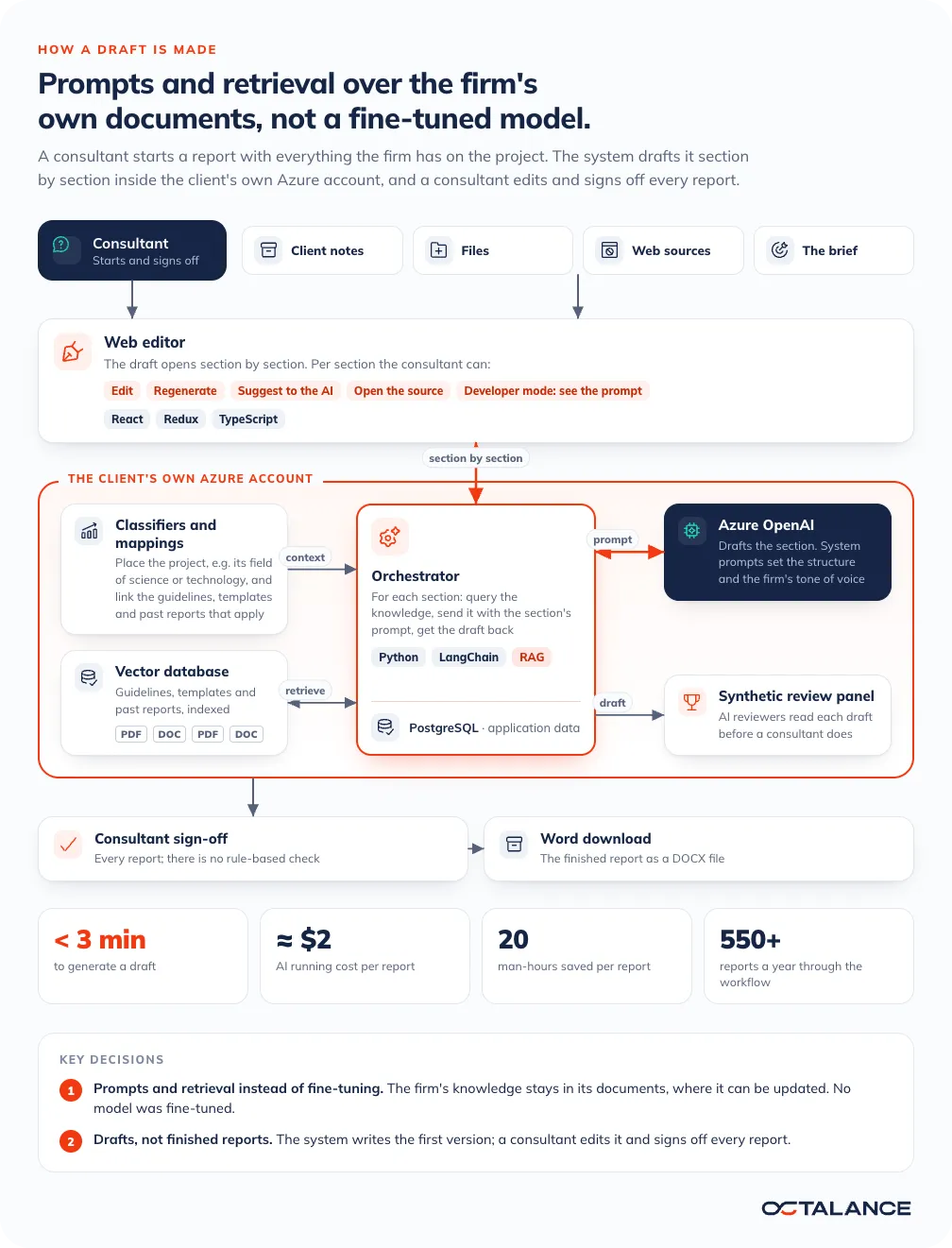
We built a generative AI system on Azure OpenAI that drafts both of the firm's report types, in its own Azure account. A consultant starts with the client notes, files, web sources and brief. Classifiers place the project, for an R&D report in its field of science or technology, and mappings link it to the guidelines, templates and past reports that apply. Application data sits in PostgreSQL. We deployed the application into the firm's Azure account in Docker containers, through our CI/CD.
One section at a time
An orchestrator in Python and LangChain drafts the report one section at a time. For each section it pulls the knowledge that section needs from a vector database and sends it with the section's prompt to Azure OpenAI. That keeps each prompt to one section's knowledge, and a consultant can regenerate one section without the rest changing.
Drafts a consultant can edit, regenerate and trace
The draft opens in a web editor built in React, Redux and TypeScript, laid out section by section in the report's structure. On any section, a consultant can edit the text, regenerate it, give the AI a suggestion to work in, or open the source a statement came from. A developer mode shows the prompt behind each section. The finished report downloads as a Word file.
How the drafts are written
Knowledge the firm can still edit
Prompts and retrieval instead of fine-tuning
A model fine-tuned on past reports would hold the firm's knowledge in its weights, where nobody at the firm can read it or correct it. We kept it in the guidelines, templates and past reports themselves, and the model reads from them for every draft. System prompts set the structure and the firm's tone of voice.
A consultant signs off every report
The system writes drafts, and before a consultant opens one, a panel of AI reviewers reads it. They check whether each project shows the advance in science or technology and the uncertainty the claim rests on, whether the draft says anything the client's own documents don't, and whether every section of the template is there. There is no rule-based check. Then a consultant reads the draft and signs the report off.
Our client's figures
< 3 min
Draft ready, against hours by hand
About $2
AI running cost per report
20 hours
Saved per report by reviewing a draft
550+
Reports a year, at the current rate
Tech stack
Generative AI stack in the client's Azure account
Azure OpenAI
LangChain
RAG over a vector database
System prompts
Classifiers
Python
PostgreSQL
React
Redux
TypeScript
DOCX export
Azure (client's own account)
Docker
CI/CD
Experts spending their days on first drafts?
Tell us which documents your team writes again and again and where the source material lives. We reply to every inquiry within 24 hours.

Case studies