1
2
3
4
5
6
7
8
9
10
11
12
13
14
15
16
17
18
19
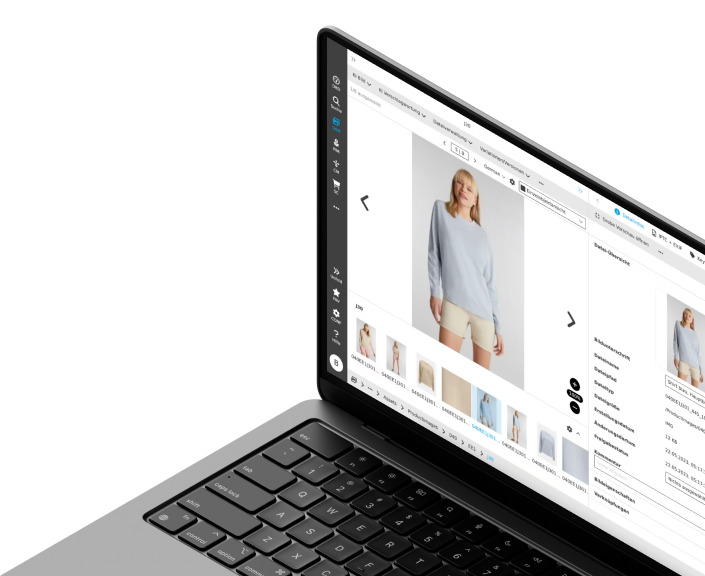
Retail & eCommerce
PIM solution used by Fortune Global 500 retailers
Updating legacy stack and developing new functionality to support millions of product records and assets
Dedicated team
1
2
3
4
5
6
7
8
9
10
11
12
13
14
15
16
17
18
19
Retail & eCommerce
PIM solution used by Fortune Global 500 retailers
Updating legacy stack and developing new functionality to support millions of product records and assets
Dedicated team
Who we worked with
Client overview
German company that builds digital solutions to modernize operations, improve efficiency, and support data‑based decision‑making for its clients.

Who we worked with
Client overview
German company that builds digital solutions to modernize operations, improve efficiency, and support data‑based decision‑making for its clients.
What we did
Project overview
- Challenge
Our client had been offering a great PIM solution but wanted more. They aspired to crush the competition by offering state-of-the-art functionality in their tool.
Our client envisioned it to handle marketing, product and workflow management in one place. They also needed to customize it for certain customers.
But all of this was impossible without upgrading the legacy stack. And it was to be done with geographically-scattered resources.
- Our Solution
We brought our deep tech expertise and solid project management practices to handle this challenge.
First, we determined a new tech stack together with our client. Then we started careful migration making sure the solution wouldn’t lose availability. When the new powerful and agile foundation was created, we started building on it.
According to the client’s specifications, we created several modules to manage product information, digital assets, distribution channels and workflow automation. They could be used separately or all at once:
– PIM (Product Information Management): Centralized and enriched product data, ensuring accuracy and consistency across catalogs, marketplaces, and digital channels.
– DAM (Digital Asset Management): Stored, organized, and transformed images, videos, and documents, supporting automated conversions and multi‑format delivery.
– WM (Workflow Management): Automated approval processes, content creation steps, and cross‑team collaboration.
– CM (Channel Management): Published product and media content to online shops, print systems, marketplaces, and other distribution endpoints.
Together, these modules allowed our client’s customers to streamline content production, reduce manual work, and deliver a unified brand experience across all customer touchpoints.
We also helped our client customize the solution for the selected customers. We studied their requirements, adapted the production cycles and regularly reported to both parties.
- Workflow
The development team operated fully remotely, following Agile methodology with structured sprints and bi-weekly demos to ensure continuous feedback and alignment. Transparent communication and progress tracking were maintained through Jira for task management and Slack for daily collaboration.
What we did
Project overview
- Challenge
Our client had been offering a great PIM solution but wanted more. They aspired to crush the competition by offering state-of-the-art functionality in their tool.
Our client envisioned it to handle marketing, product and workflow management in one place. They also needed to customize it for certain customers.
But all of this was impossible without upgrading the legacy stack. And it was to be done with geographically-scattered resources.
- Our solution
We brought our deep tech expertise and solid project management practices to handle this challenge.
First, we determined a new tech stack together with our client. Then we started careful migration making sure the solution wouldn’t lose availability. When the new powerful and agile foundation was created, we started building on it.
According to the client’s specifications, we created several modules to manage product information, digital assets, distribution channels and workflow automation. They could be used separately or all at once:
– PIM (Product Information Management): Centralized and enriched product data, ensuring accuracy and consistency across catalogs, marketplaces, and digital channels.
– DAM (Digital Asset Management): Stored, organized, and transformed images, videos, and documents, supporting automated conversions and multi‑format delivery.
– WM (Workflow Management): Automated approval processes, content creation steps, and cross‑team collaboration.
– CM (Channel Management): Published product and media content to online shops, print systems, marketplaces, and other distribution endpoints.
Together, these modules allowed our client’s customers to streamline content production, reduce manual work, and deliver a unified brand experience across all customer touchpoints.
We also helped our client customize the solution for the selected customers. We studied their requirements, adapted the production cycles and regularly reported to both parties.
- Workflow
The development team operated fully remotely, following Agile methodology with structured sprints and bi-weekly demos to ensure continuous feedback and alignment. Transparent communication and progress tracking were maintained through Jira for task management and Slack for daily collaboration.
What the solution looked like
Interface showcase
Each module had a well-thought-out intuitive interface to ensure a smooth user experience.
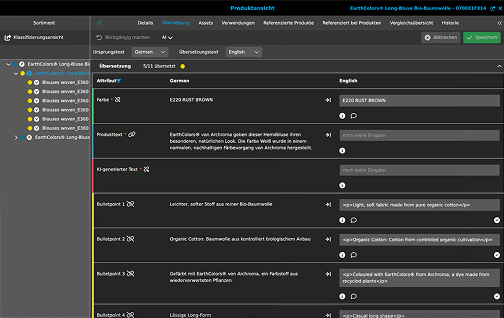
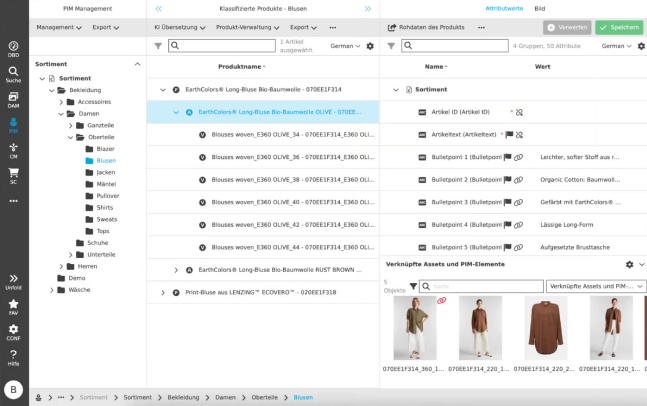
PIM module
Brought all product information into one place, making it easy for teams to manage every detail — from attributes and descriptions to translations and linked media.
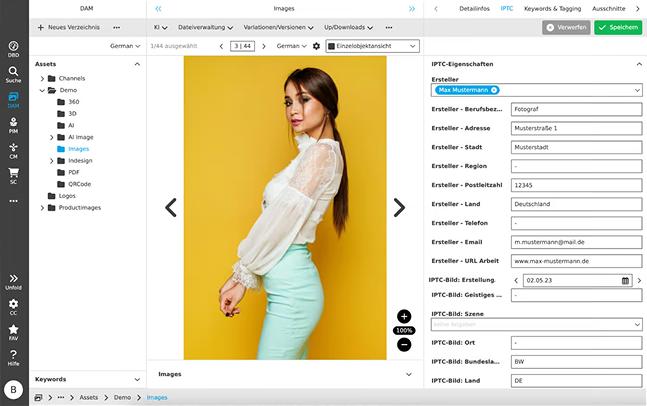
DAM module
Stored assets in a clean, searchable library, enriches them with metadata, and supports editing tasks like cropping or preparing channel‑specific versions.
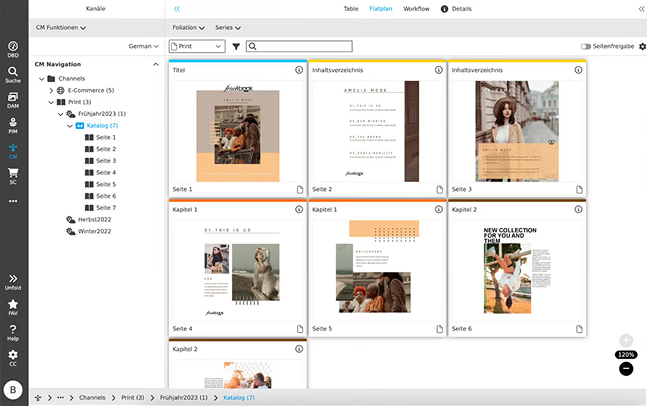
CM module
Allowed users to structure assortments, adjust metadata, and prepare channel‑specific versions of product information — whether for marketplaces, e‑commerce shops, or print catalogs.
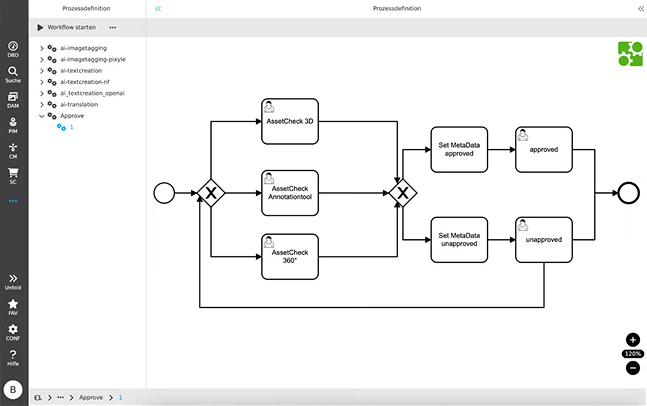
WFM module
Let teams define clear workflows for tasks like product creation, translation, metadata checks, asset approval, and print layout production.
What the solution looked like
Interface showcase
Each module had a well-thought-out intuitive interface to ensure a smooth user experience.
PIM module
Brought all product information into one place, making it easy for teams to manage every detail — from attributes and descriptions to translations and linked media.
DAM module
Stored assets in a clean, searchable library, enriches them with metadata, and supports editing tasks like cropping or preparing channel‑specific versions.
CM module
Allowed users to structure assortments, adjust metadata, and prepare channel‑specific versions of product information — whether for marketplaces, e‑commerce shops, or print catalogs.
WFM module
Let teams define clear workflows for tasks like product creation, translation, metadata checks, asset approval, and print layout production.
What our client achieved
40%
Reduced manual effort when preparing campaigns
30%
Shortened production cycle when launching new products
>1M
Database records processed for top global retailers
What our client achieved
40%
Reduced manual effort when preparing campaigns
30%
Shortened production cycle when launching new products
>1M
Database records processed for top global retailers
Repeat the success
Want to build something similar?
Leave us your details and we’ll contact you soon to understand your business needs


About you
About your project